Blog | LuxLiving

Dubai Real Estate Market 2026: Will Property Prices Crash?

Dubai Real Estate Market 2026: Will Property Prices Crash?

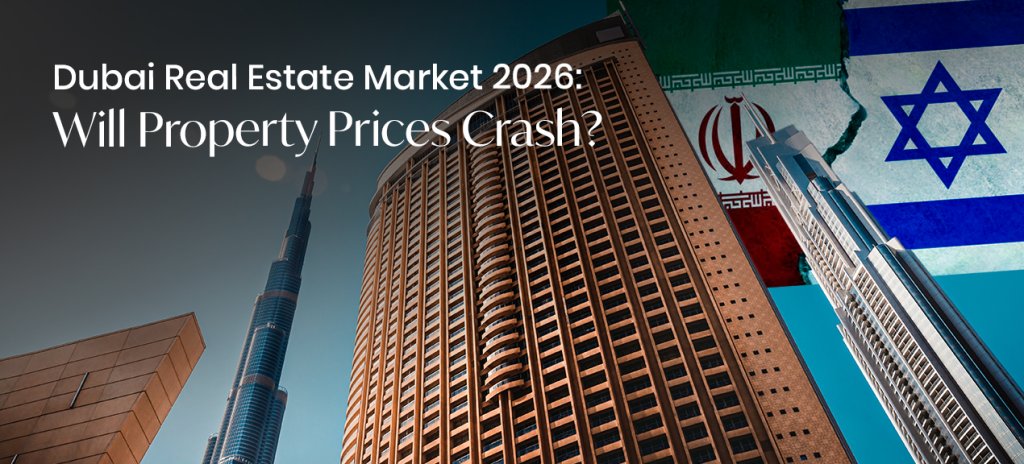
Many investors are wondering if the Dubai real estate market would crash in light of the escalating tensions between Iran and Israel. The most recent data from early March 2026 reveals a different story, despite the fact that headlines can often spark fear.

Although Dubai has long been seen as a secure haven for foreign investors, stability issues are frequently brought up by geopolitical uncertainty. In this blog, let’s break down the current Dubai real estate market scenario in 2026, how global tensions could affect it, and whether investors should worry about a potential market crash.

Current Dubai Real Estate Market Scenario: Will the Market Crash?

Recent tensions between Iran and Israel have created instability in the region, which has forced some investors to pause their plans of buying a property in Dubai.

But uncertainty doesn’t mean a crash. Despite worldwide crises, Dubai’s real estate market has remained strong. Over 270,000 transactions totaling AED 917 billion were recorded in the Dubai real estate market in 2025; 86% of these sales were paid for with cash rather than mortgages.

Crashes usually happen with high debt and panic selling, neither of which exists in Dubai today, and the market remains stable.

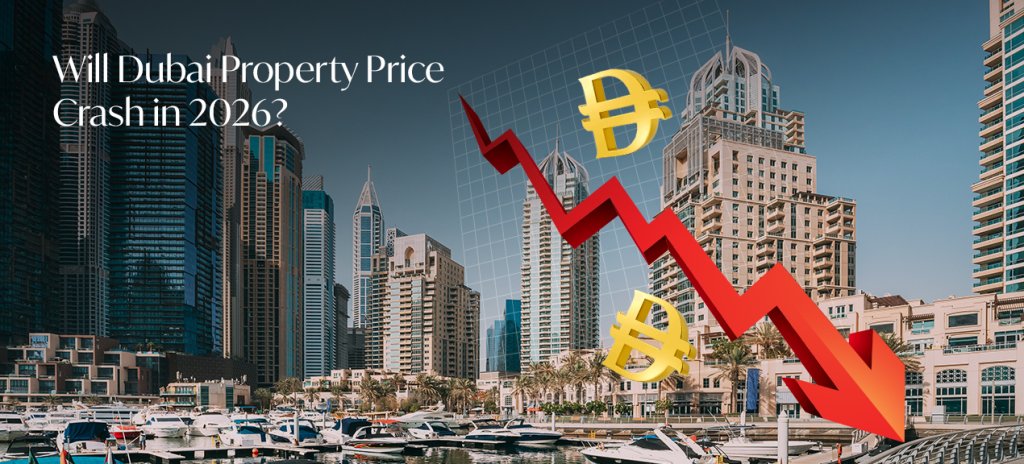
Will Dubai Property Prices Crash in 2026?
Dubai Property Prices Crash

Currently, this is the most popular question on the internet. A crash in Dubai real estate is unlikely, according to the majority of real estate analysts.

Even before the conflict, rating agency Fitch had predicted a possible 10–15% price adjustment in some areas, primarily as a result of an increase in new supply. However, the majority of specialists expect a correction rather than a collapse.

Prime communities like Downtown Dubai, Palm Jumeirah, Dubai Hills Estate, and Dubai Marina are expected to hold or increase in value, making now a good time to invest in Dubai real estate in 2026.

After years of rapid growth, Dubai’s real estate is entering a stabilization phase:

  • Moderate price adjustments in some areas
  • Stability or growth in prime and luxury properties
  • The overall market is maturing, not collapsing

Property prices are projected to grow 5–8% annually through 2026, depending on location and property type.

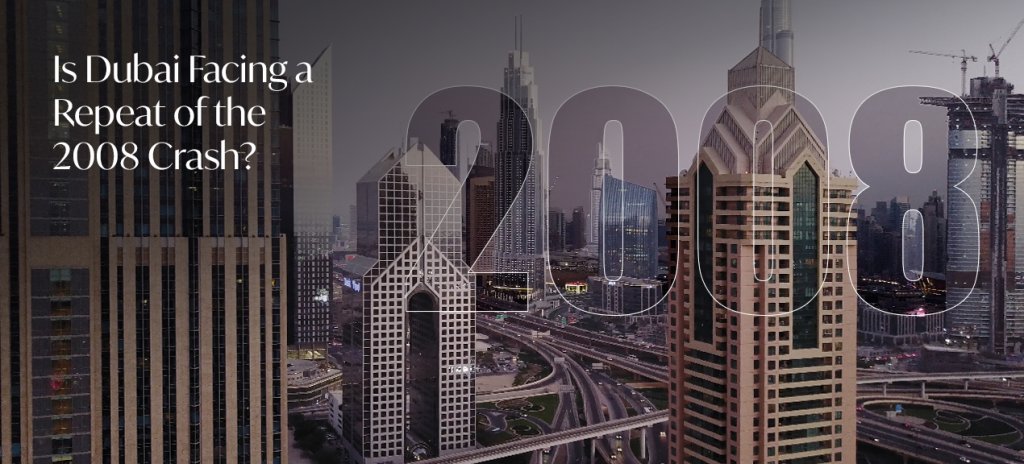
Is Dubai Facing a Repeat of the 2008 Crash?
dubai real estate market crash 2008

This comparison comes up every time there’s turbulence in the Dubai real estate market, but it doesn’t apply.

In 2008, Dubai’s market was overleveraged, underregulated, and built on speculation; however, in 2026, 90% of sales in 2026 are cash-funded, buyers are protected by RERA’s strict escrow regulations, and the majority of buyers are end users rather than investors flipping properties. There are no longer any vulnerabilities that led to the 2008 crash.

How Do Global Conflicts Typically Impact Dubai Real Estate?

Wars and geopolitical tensions usually affect property markets in three ways:

  1. Short-term uncertainty: Investors may delay property buying decisions until the situation becomes clearer.
  2. Temporary slowdown in transactions: While buyers wait, real estate market activity may temporarily decline.
  3. Long-term capital relocation: Stable global cities tend to attract wealth, and Dubai has historically profited from this trend.

As investors relocate their money to safer and more tax-efficient areas, Dubai has actually seen an increase in investment during global instability.

Should You Buy Now or Wait?
The fundamentals are strong if you’re making a long-term investment in Dubai real estate, whether it’s for personal use, rental income, or a 5+ year investment. The population of Dubai exceeded 4 million in 2025 and is predicted to increase by 175,000 to 225,000 in 2026, maintaining a high demand for real estate.

The next six to twelve months are more risky if you’re looking for a quick flip. Pay attention to reputable developers, well-established neighborhoods with high rental demand, and regions with high rental demand.

The average rental yield in Dubai is approximately 7%, which is significantly higher than in Singapore, London, or New York. Buy-to-let investors can still make good money even if real estate sales temporarily decline.

Conclusion: Why Dubai’s Real Estate Remains Resilient

Dubai’s real estate market is resilient and stable despite the short-term uncertainty brought on by the Israel-Iran conflict. Today’s real estate market is far safer than it was during previous crises like 2008 due to strict regulations, escrow protections, long-term golden visas, and a wide range of international buyers.

The demand for real estate is still supported by Dubai’s expanding population, high rental yields, and consistent economic growth. Investor interest is still high, and international capital is still coming into the city, even though some buyers might take a pause.

In short, Dubai’s real estate market is stabilizing rather than crashing. This is a great chance for long-term investors to see consistent growth in a safe, well-regulated market. Every crisis in Dubai’s history has resulted in a stronger recovery, and 2026 is no exception, so whether you’re looking for a home or an investment, visit LuxLiving to explore more properties in Dubai.

FAQs

1. Are property prices going to fall in Dubai?

Instead of a sharp decline, experts suggest moderate price moderation or correction in some segments; prices may stabilize or slightly decline as supply rises, but core demand is still strong.

2. Is Dubai under threat now?

Industry leaders and analysts claim that despite regional geopolitical tensions, Dubai’s real estate market is resilient and stable due to solid investor confidence and underlying economic fundamentals.

3. Will property prices fall in Dubai in 2026?

While some predictions point to slower growth or slight corrections in some areas in 2026, overall prices are expected to either stay steady or grow slightly rather than fall.

4. What is the future of Dubai real estate?

The future of Dubai real estate will be a stable, balanced market with sustained demand, high rental yields, and continued interest from international investors.

5. What is the forecast for Dubai property for the next 5 years?

Analysts predict that the Dubai real estate market will see moderate price growth overall over the next five years, particularly in prime areas, due to population growth, persistent demand, and economic resilience.
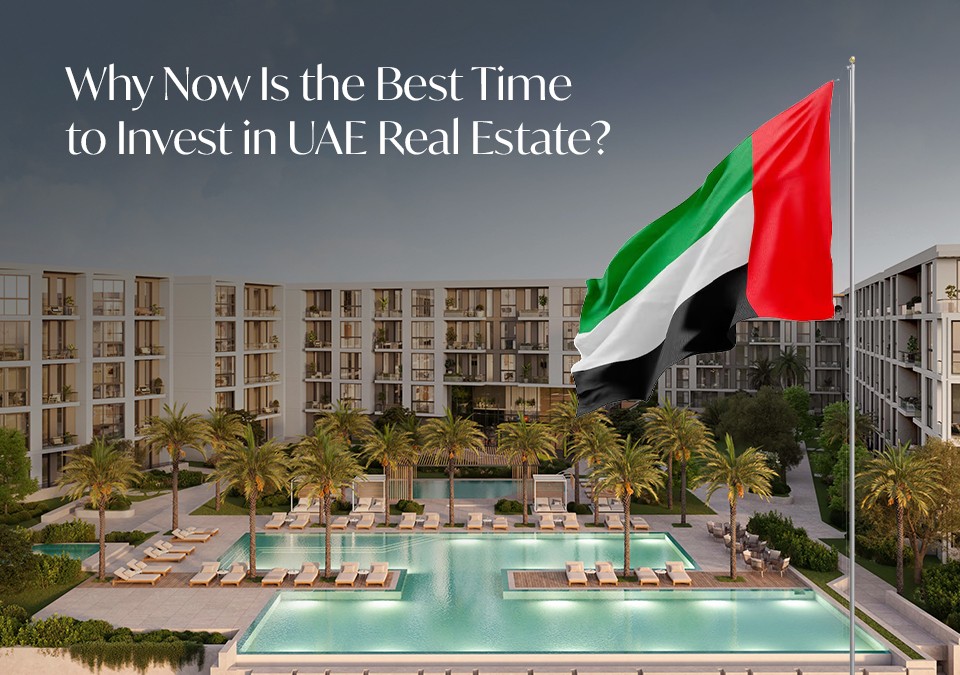
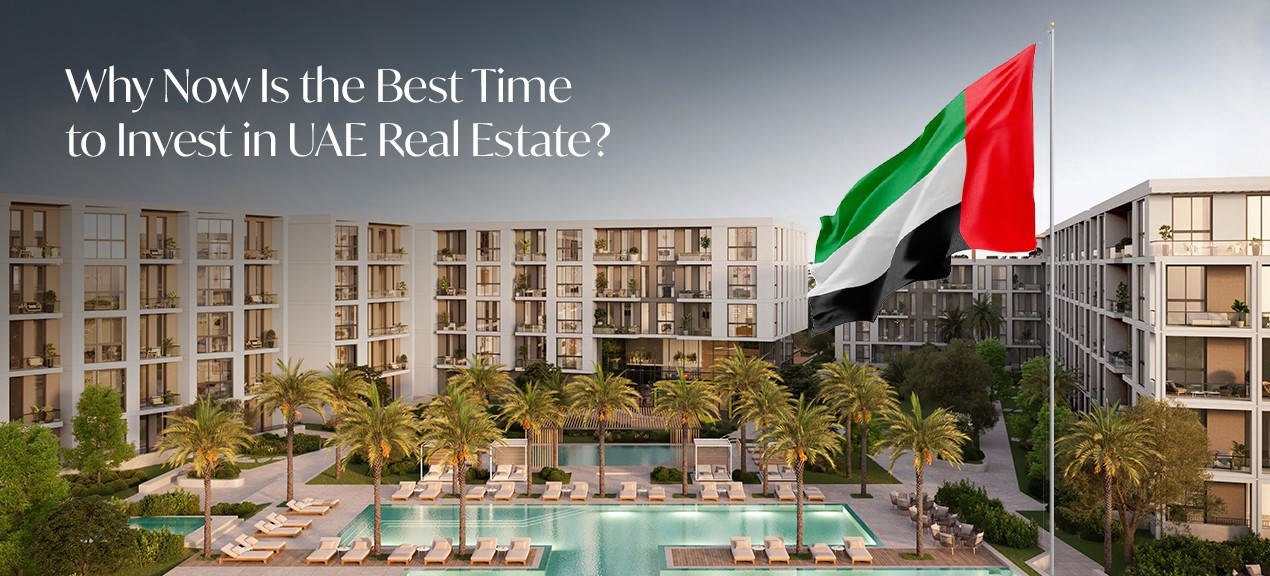
Is Now a Good Time to Invest in Dubai Real Estate? 2026 Market Outlook

Is Now a Good Time to Invest in Dubai Real Estate? 2026 Market Outlook
invest in Dubai real estate

The UAE real estate market in 2026 is showing signs of slowing down, as some buyers pause buying property in Dubai, amid regional uncertainties. But this brief slowdown doesn’t mean the Dubai real estate market is weak. 

So, is it a good time to buy property in Dubai?

Yes, the Dubai real estate market is still active, rental yields are high, and luxury properties in Dubai continue to be strong. The UAE is still a secure and lucrative area to invest because of its track record of recovering from previous crises. In this blog, let’s understand the current situation of the Dubai real estate market, what to expect in the upcoming months, and why this is the ideal time to buy real estate in the UAE.

Current Status in the UAE Real Estate Market in 2026

Instead of panicking, investors are being cautious. The Dubai real estate market is still strong but is modestly slowing as buyers take a wait-and-watch approach before buying a property in Dubai.

Here are some facts which buyers can analyse before investing in Dubai real estate:

  • Slower Transactions: As buyers look for clarification, closures are taking longer.
  • Careful Negotiations: Buyers are negotiating more pricing and payment plans.
  • Stability of Luxury Property: Places like Business Bay, Palm Jumeirah, and Downtown Dubai continue to be strong.
  • Strong Rental Market: Tenants and investors are still drawn to rental yields of 6–9%.

According to a recent Khaleej Times report from March 2026, real estate in the UAE is defying regional tensions. A property sale worth over $100 million was recorded in Dubai, indicating that investor demand is still high. With more than AED 30 billion in available liquidity, developers such as Aldar Properties have assured continuous operations. 

While some foreign purchasers have chosen to wait and see, brokers on the ground observe that ongoing transactions are proceeding as usual, and developers are keeping launch pricing the same while providing more flexible payment options to maintain investor trust.

What to Expect from UAE Real Estate in 2026?

invest in Dubai real estate

The UAE real estate experts suggest that there might be normalization in properties rather than a decrease, even with short-term caution. Here are the price and market trends that investors can expect:

  • Price Adjustments: Small adjustments of 5–15% may be made to mid-market homes.
  • Change in Negotiating Power: Sellers may give 3–7% discounts; buyers have more leverage.
  • Developer incentives include fee support, service charge waivers, and post-handover payment options.

Property Type Outlook

  • Off-Plan Properties: Due to their flexible payment options, bookings and reservations may be a little slower.
  • Ready Properties: More negotiating and longer days in the Dubai real estate market. 
  • Luxury Assets: Due to their high demand and restricted supply, they are limited. 
  • Mid-Range Housing: Due to supply pressures, this sector is most impacted by short-term moderation.

How Has the UAE Recovered From Past Market Crises?

invest in Dubai real estate

The Dubai property market has a track record of recovering and bouncing back stronger:

  • 2008 Financial Crisis: Strong growth for long-term investors followed a temporary downturn.
  • COVID-19 Pandemic: The Dubai real estate market was disrupted, but as clarity restored, it soon recovered.

Here are some of the important factors that influence resilience:

  • The Dubai population is growing to around 4 million people.
  • Strong foreign investment and business-friendly regulations
  • Diversification of the economy outside of oil
  • Long-term, strategic infrastructure development. 

Overall, the Dubai real estate market doesn’t just recover; it grows stronger after every challenge it faces. 

Why Now Is the Right Time to Invest in Dubai Real Estate?

Temporary real estate market moderation can benefit strategic investors because of the following reasons:

  • Prime Locations Hold Value: Luxurious and strategically located properties are still in high demand.
  • Flexible Payment Options: Investments in off-plan projects don’t require instant, full capital.
  • Attractive Rental Yields: During uncertain times, cash flow is provided by 6–9% yields.
  • Timing Advantage: Opportunities arise from temporary price adjustments and less resistance to negotiations.

Investors who focus on quality properties, strategic locations, and long-term value are best positioned to benefit from the current market environment.

Conclusion: Why Invest in Dubai Real Estate

The big question is, is it the right time to invest in the Dubai real estate market considering the ongoing uncertainties?

The answer is yes. The fundamentals of the UAE real estate market remain strong, although some buyers are cautious and some segments may temporarily moderate

The UAE has consistently shown that it can withstand shocks from around the world and recover stronger, providing investors with:

  • Safety and stability
  • Opportunities for attractive rental revenue
  • Long-term growth in capital

Overall, this is a great opportunity to invest in real estate in the UAE and benefit from long-term growth. If you’re looking to explore and buy properties for sale in Dubai, visit Luxliving and get in touch with the top real estate agents. 

FAQs

1. Is now a good time to buy a property in the UAE?

Yes, many experts say 2026 can be a good time for long-term investors to buy property in the UAE. The market is supported by strong demand, population growth, and rental returns of 6-7%. 

 2. What is the 2% rule for properties?

According to the 2% rule, for a property to have strong cash flow, the monthly rent should be around 2% of the purchase price. Its primary purpose is to compare investment properties quickly.

3. What is the rule of 7 in real estate?

According to the Rule of 7, a property’s value may double in seven to ten years if it increases by roughly 7% a year. It is used by investors to project long-term growth.

4. Why is it now the best time to invest in real estate?

Dubai real estate offers stable income, long-term price growth, and protection against inflation. When markets slow slightly, buyers may also get better prices and negotiation opportunities.

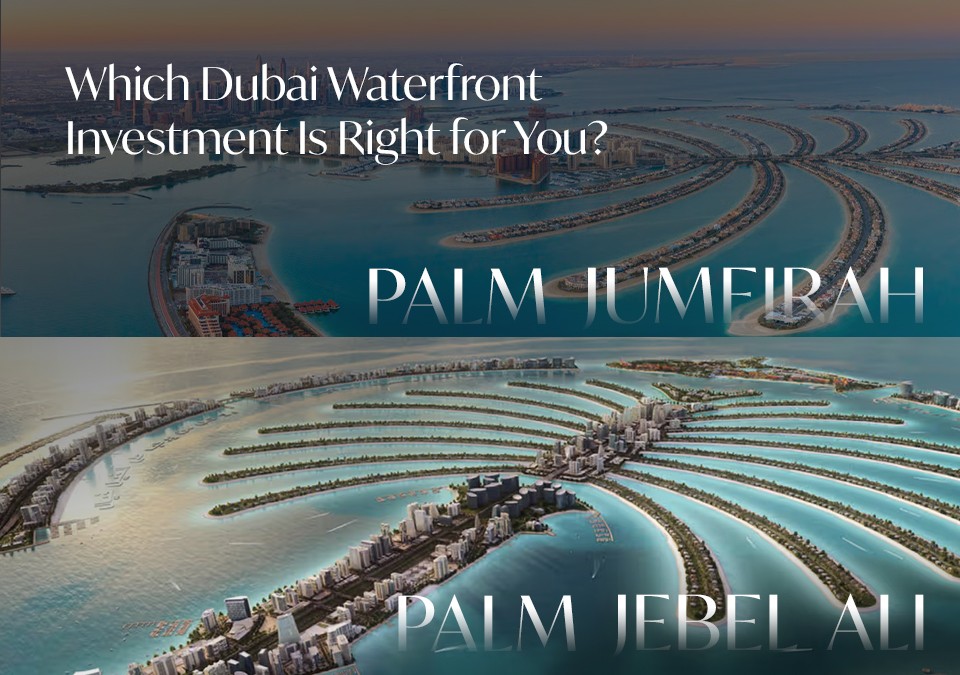
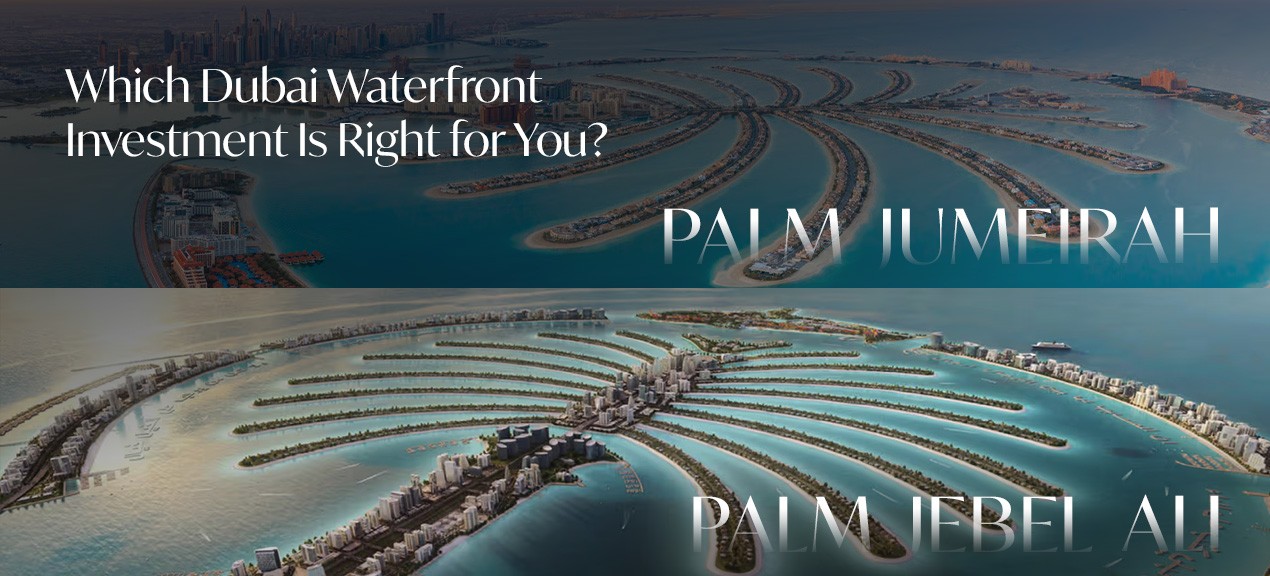
Palm Jumeirah vs. Palm Jebel Ali: Which Dubai Waterfront Investment Is Right for You?

Palm Jumeirah vs. Palm Jebel Ali

Dubai’s waterfront real estate market continues to attract global investors seeking capital preservation, high rental yields, and long-term appreciation. The Dubai real estate industry is dominated by two well-known brands: Palm Jumeirah and Palm Jebel Ali.

If you’re looking to invest in Dubai’s prime waterfront properties, choosing between these two iconic islands is more strategic than it seems. They aren’t competitors.

They represent different stages of growth, different risk levels, and different investment timelines. Understanding the difference is key before you invest even one dirham.

Palm Jumeirah vs. Palm Jebel Ali Investment

Tabulated below is a differentiation between Palm Jumeirah vs Palm Jebel Ali:

Palm Jumeirah Palm Jebel Ali 
Palm Jumeirah, a fully functional luxury island with 61 million square feet and a 78-kilometer coastline, was built between 2001 and 2006. Home to Atlantis The Palm, five-star hotels, and thousands of premium residences. It is one of the most recognized addresses on the planet.Palm Jebel Ali is the next generation. With 147 million square feet and more than 110 kilometers of shoreline, this island is almost twice as large as Palm Jumeirah. Nakheel is currently developing it, and Phase 1 handovers are anticipated between 2026 and 2027. Up to 250,000 people are expected to live there when it is finished, and there will be more than 80 hotels and resorts. 

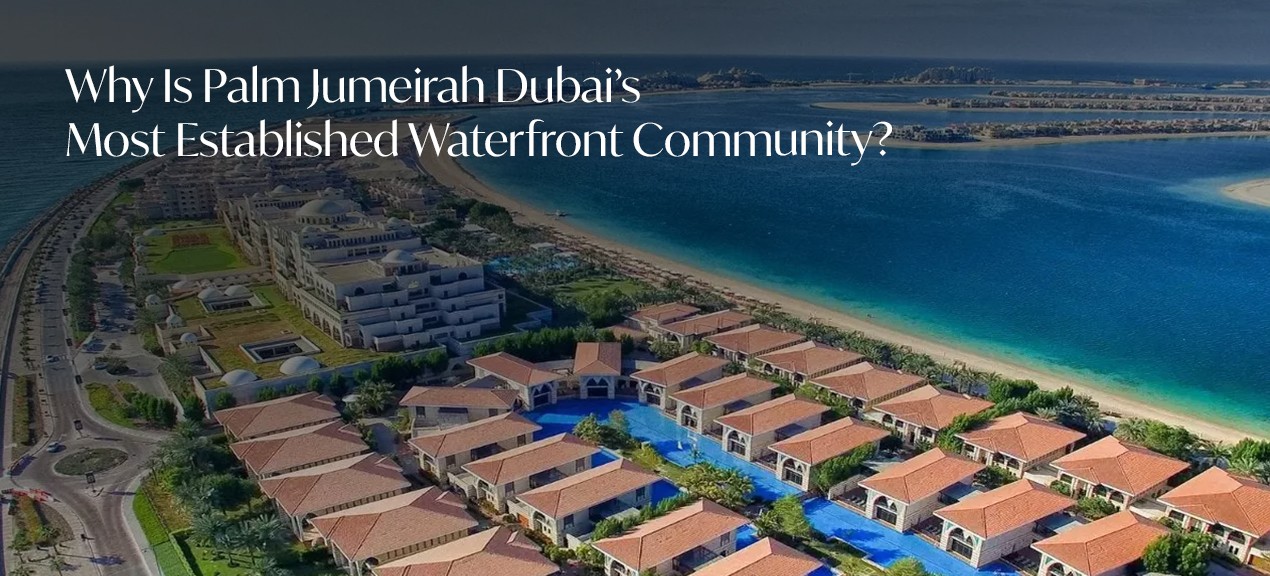
Why Is Palm Jumeirah Dubai’s Most Established Waterfront Community?

One of the world’s most iconic artificial islands is Palm Jumeirah. It has come to represent ultra-luxury seaside living since its introduction in the early 2000s. These are some key investment facts:

  • One of the best-performing ultra-prime villa markets in Dubai
  • Limited supply with approximately 2,000 signature villas on the fronds.
  • High demand from buyers abroad (Europe, CIS, UK, India)
  • Premium resale liquidity in comparison to the majority of areas in Dubai
  • For prime villas, rental yields usually fall between 4 and 6% (depending on the property category).

Infrastructure & Connectivity

Palm Jumeirah offers seamless connectivity to the following:

It is home to luxury resorts such as the following:

  • Atlantis The Palm
  • Atlantis The Royal

This established ecosystem supports consistent rental demand and long-term value stability.

Why Invest in Palm Jumeirah?

  • Proven capital appreciation track record
  • Scarcity-driven value protection
  • Immediate rental income potential
  • Globally recognized address

Palm Jumeirah is one of Dubai’s safest luxury real estate options if you want to protect your wealth and hold prime assets.

What Makes Palm Jebel Ali Different?

Launched in 2002, Palm Jebel Ali was formally reopened in 2023 with a new master plan that was in line with the Dubai 2040 Urban Master Plan. The new vision includes:

  • Over 80 hotels and resorts (planned)
  • Significantly longer coastline than Palm Jumeirah
  • Lower-density residential planning
  • Contemporary smart infrastructure
  • Larger waterfront villa plots

Located near Dubai South and close to Al Maktoum International Airport, Palm Jebel Ali is a part of Dubai’s long-term growth corridor.

Why Invest in Palm Jebel Ali?

Here are some reasons why investors are choosing to invest in Palm Jebel Ali in 2026: 

  • Early-entry pricing with substantial potential for future growth
  • Bigger plots and contemporary master planning with an emphasis on sustainability
  • Possibility of long-term capital growth

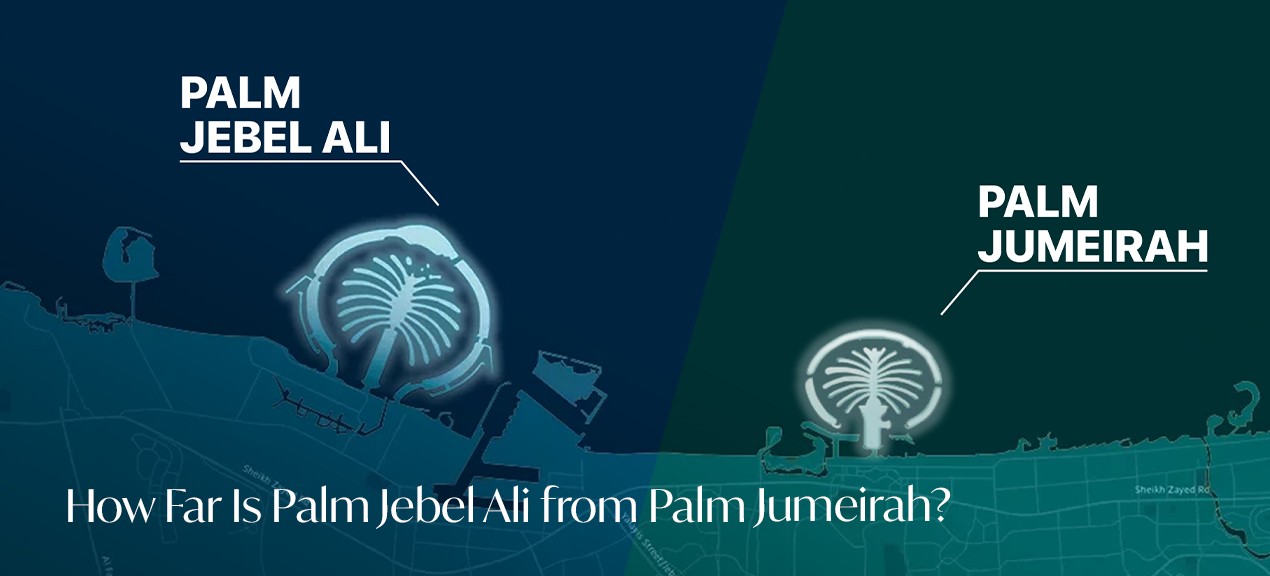
How Far Is Palm Jebel Ali from Palm Jumeirah?

palm jumeirah vs palm jebel ali

Palm Jebel Ali is located approximately 30–40 minutes by car from Palm Jumeirah, depending on traffic.

While Palm Jumeirah is situated within central Dubai’s luxury areas, Palm Jebel Ali is located in a future growth zone focused on expansion, aviation, and large residential development.

If you’re looking at long-term city growth potential, Palm Jebel Ali offers strong future positioning.

Palm Jumeirah vs Palm Jebel Ali: Rental Yields & Capital Appreciation Potential

Here’s an overview of the rental yields and capital appreciation for the Palm Jumeirah vs Palm Jebel Ali:

Palm Jumeirah

  • High demand for short-term rentals (luxury leasing & vacation houses)
  • Established ultra-prime resale market
  • Stronger capital stability but a lower yield than in mid-market regions

Palm Jebel Ali

  • Limited short-term rental activity (under development)
  • Appreciation tied to infrastructure delivery milestones
  • Increased timeline risk and potential upside

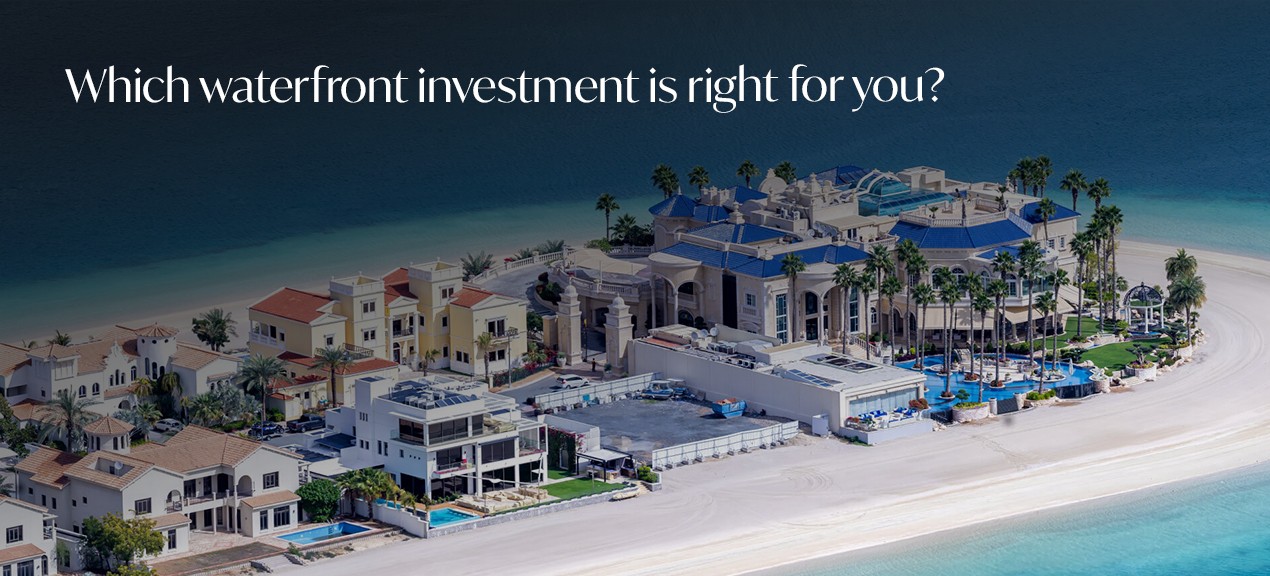
Palm Jumeirah vs Palm Jebel Ali: Which waterfront investment is right for you?

Palm jumeirah vs palm jebel ali

It’s not about which island is better. It’s about your goals.

Choose Palm Jumeirah if you want:

  • Beachfront living
  • Demonstrated price stability
  • High demand for rentals
  • Simple potential for resale

Choose Palm Jebel Ali if you want:

  • Early-entry pricing
  • Larger waterfront plots
  • Exposure to Dubai’s long-term growth plans
  • A future-focused investment strategy

Many high-net-worth buyers choose both, investing in Palm Jebel Ali for long-term growth and potential while living on Palm Jumeirah for stability now.

Conclusion 

Overall, Dubai’s waterfront real estate outlook for 2026 is still favorable due to the absence of an annual property tax, the city’s growing population of over 3.7 million residents, the increase in wealth migration from around the world, and its reputation as a safe-haven investment market. Waterfront properties are still among the UAE’s most limited and globally competitive assets.

Due to its tax-free income, strong property rights, and one of the most active real estate markets in the world, Dubai continues to draw over 6,500 high-net-worth individuals each year. Due to their freehold status, both Palm Islands are available to foreign purchasers with complete ownership rights.

Selecting the investment that best suits your timetable, risk tolerance, and long-term objectives is more important than picking the “better” palm

FAQS

1. What is the main difference between Palm Jumeirah and Palm Jebel Ali?

Palm Jumeirah is fully developed and ready for living and rental income today, while Palm Jebel Ali is a newly relaunched, larger waterfront project still under development with long-term growth potential.

2. Is Palm Jebel Ali bigger than Palm Jumeirah?

Yes, Palm Jebel Ali is significantly larger and is planned to have a longer coastline and more residential units compared to Palm Jumeirah.

3. Which palm is more luxurious?

Palm Jumeirah is currently more established in terms of ultra-luxury resorts, branded residences, and beachfront villas, but Palm Jebel Ali is planned as a next-generation luxury waterfront destination.

4. How far is Palm Jumeirah from Palm Jebel Ali?

Palm Jebel Ali is located approximately 30–40 minutes by car from Palm Jumeirah, depending on traffic.

5. Why was Palm Jebel Ali stopped?

Construction of Palm Jebel Ali was stopped because of the 2008 global financial crisis. The economic downturn affected many major projects in Dubai, so work on the island was paused for over a decade. 

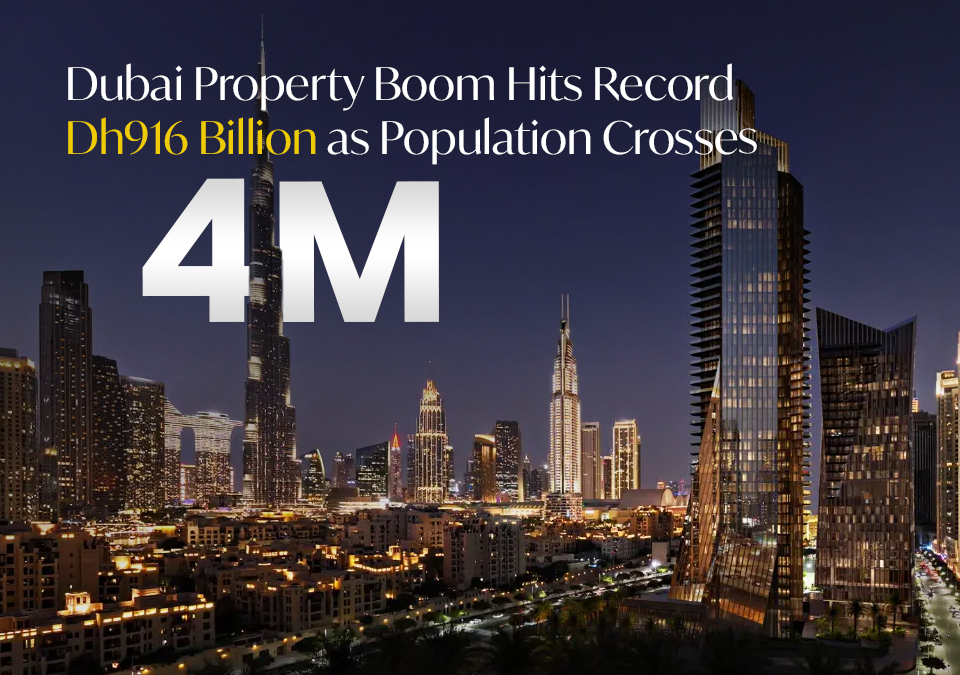
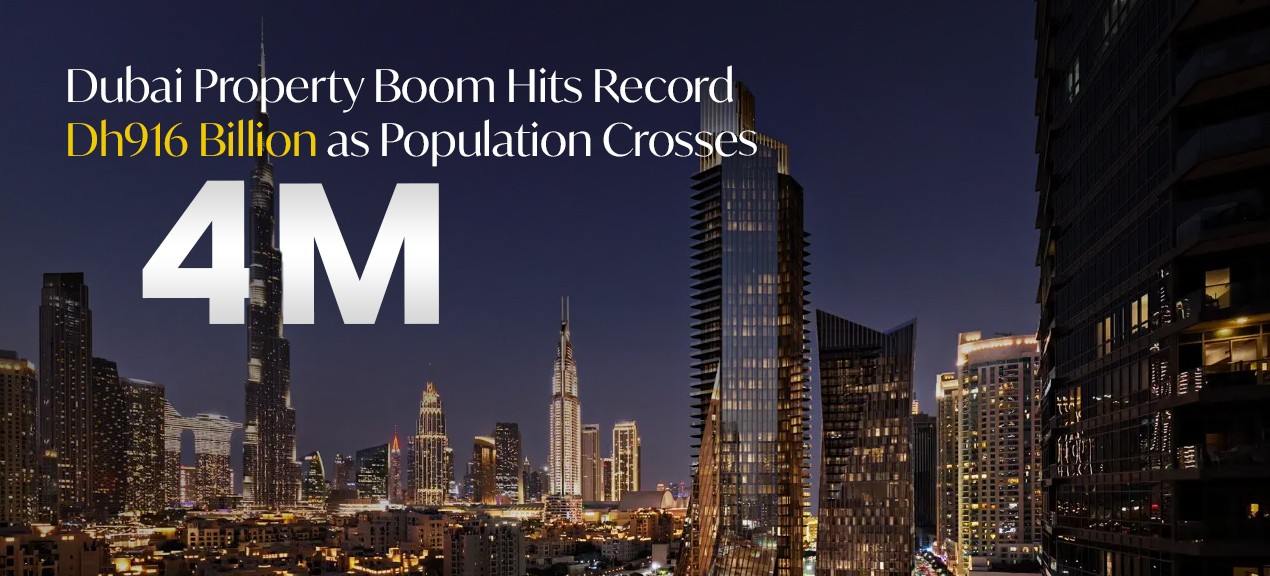
Dubai Property Boom Hits Record Dh916 Billion as Population Crosses 4 Million

Dubai Real Estate 2026

Dubai’s real estate market has entered 2026 with unprecedented growth, with the total property transactions reaching Dh916 billion, marking it as the highest level ever recorded in the emirate.

This increase is not the result of speculation, but rather of population growth, economic prosperity, and ongoing investor confidence around the world.

If you are closely looking at the Dubai real estate 2026, here’s what the numbers really mean and why this cycle looks fundamentally strong.

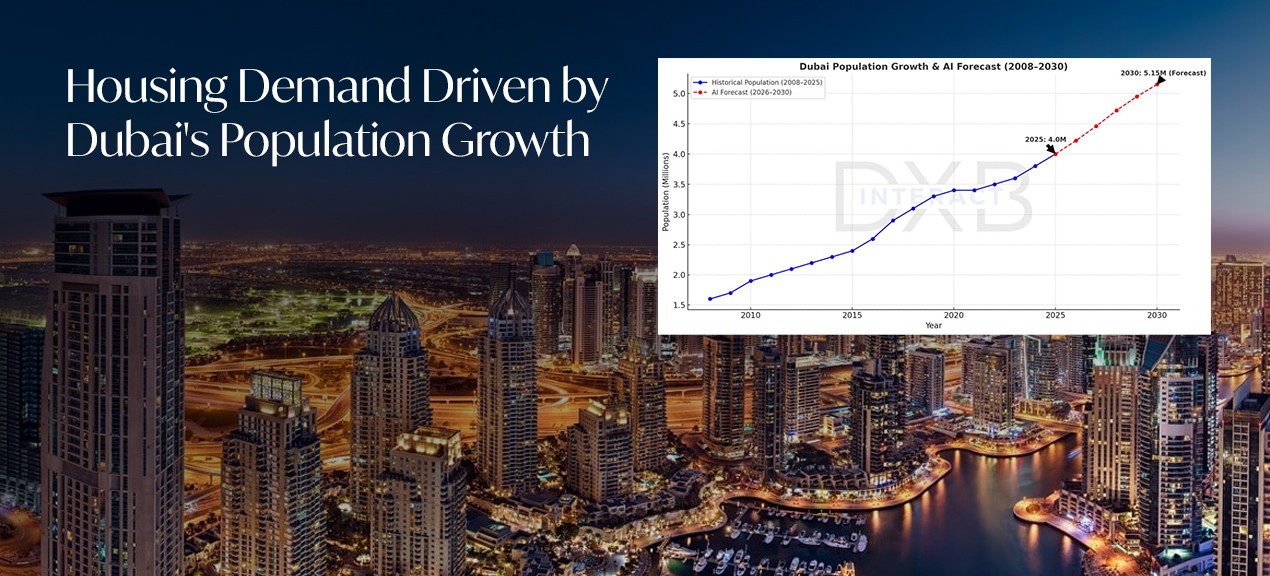
Housing Demand Driven by Dubai’s Population Growth

Dubai Real Estate 2026

Recently, Dubai surpassed 4 million residents, solidifying its standing as a global center for high-net-worth individuals, professionals, and businesses.

The city welcomed around 18,000 new citizens in August 2025 alone. This expansion is not seasonal; rather, it is the result of consistent migration caused by 

  • Corporate relocation 
  • Job creation
  • Tax-efficient living
  • Lifestyle and safety advantages

This consistent population inflow directly increases demand for:

  • Rental properties in desirable neighborhoods
  • Waterfront residences and luxury villas
  • Mid-range apartments close to commercial areas

Compared to the earlier cycles, today’s demand is mostly driven by end users, people who are moving permanently, not just short-term speculators.

Dh916 Billion in Transactions: A Record for Dubai Real Estate

According to official data from the DLD data, the Dubai real estate closed 2025 with:

  • Over Dh680 billion in real estate transactions
  • Over 200,000 real estate deals
  • Dh916 billion in total, including mortgages and other transactions

The highest quarterly performance in Dubai’s history occurred in the last quarter of 2025, when revenues topped Dh187 billion.

Dubai Luxury Real Estate Remains Exceptionally Strong

dubai real estate 2026

The prime and ultra-prime segments continue to outperform, with nearly 6,000 transactions above Dh10 million completed in 2025. 

Limited supply in established communities has supported the following:

  • Capital appreciation
  • Strong rental rates
  • Continued demand from high-net-worth individuals

Dubai remains one of the top-performing global cities for luxury villas and prime residential properties, competing with major markets across Europe and Asia-Pacific.

Mortgage Rate Cuts Boost Buyer Confidence in 2026

dubai real estate 2026

In late 2025, the UAE Central Bank made policy adjustments, where the benchmark interest rates were lowered. This has gradually lowered mortgage costs across the UAE banking system.

  • New purchasers joining the market
  • Renters will eventually become owners
  • Investors to acquire assets that will generate income throughout time

Transaction activity is expected to be strong throughout 2026 as borrowing prices decline.

Dubai Rental Yields Remain Among the Highest Globally

Rental yields in Dubai are still much higher than in many developed real estate markets, particularly in mid-market and well-connected neighborhoods.

Strong rental demand is supported by

  • Population growth
  • Corporate relocations
  • Limited immediate supply in key areas
  • Expanding infrastructure

Dubai still has a strong risk-reward ratio for foreign investors looking for assets that generate income.

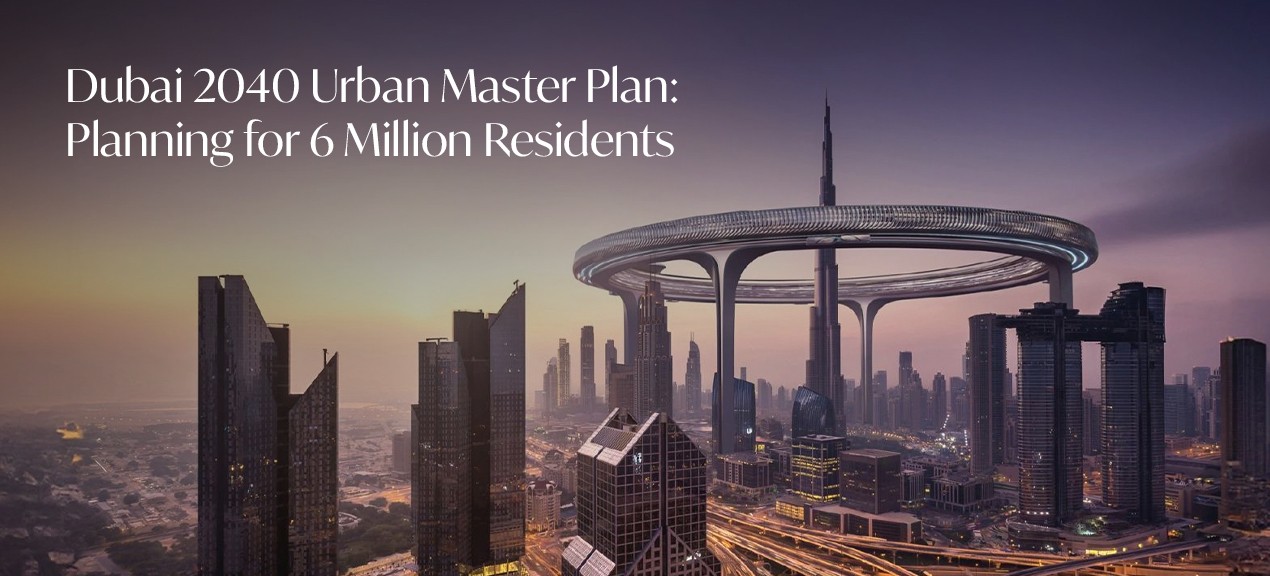
Dubai 2040 Urban Master Plan: Planning for 6 Million Residents

dubai real estate 2026

Disciplined planning is essential for long-term stability, and Dubai has already planned its next stage.

By 2040, the city should be ready for a population of around 6 million, according to the Dubai 2040 Urban Master Plan. Key pillars include:

  • Residential community expansion
  • Better transport networks
  • Improved social infrastructure
  • Focus on liveability and sustainability

This structured growth model reduces the risk of uncontrolled oversupply and reinforces investor confidence in Dubai’s long-term property fundamentals.

Conclusion  

More than a record, the Dh916 billion milestone shows how durable and structurally sound the Dubai real estate 2026 market is. Important lessons for investors and purchasers include:

  • Demand from the population is generating steady growth in every sector.
  • mature market characteristics that provide transparency and stability
  • sustained international capital inflows that boost performance in the prime and midmarket
  • Resilient premium and mid-market real estate with attractive rental returns

So, if you’re looking for luxury villas, waterfront properties, or apartments for sale, explore Dubai’s top real estate opportunities with LuxLiving today.

Escrow Account in Dubai Real Estate: What Every Off-Plan Buyer Must Know

escrow in dubai real estate
escrow account in dubai real estate

If you’re buying off-plan property in Dubai, one of the most important terms you’ll hear is escrow account.

But what exactly is an escrow account in Dubai real estate, and how does it protect your money? In order for every off-plan buyer to understand what escrow accounts are, let’s break it down in this guide.

What Is an Escrow Account in Dubai Real Estate?

In Dubai real estate, an escrow account is a bank account that is regulated and used to hold buyer payments for off-plan projects while they are in the construction phase. Dubai Land Department (DLD) and Real Estate Regulatory Agency (RERA) supervise these escrow accounts in Dubai.

It acts as a safe intermediary between the developer and you, the buyer. The developer does not immediately keep your money. As an alternative, the money remains in a Dubai RERA escrow account until the developer meets authorized building milestones.

This is one of the main reasons why Dubai is considered the safest real estate market across the world for off-plan investors. 

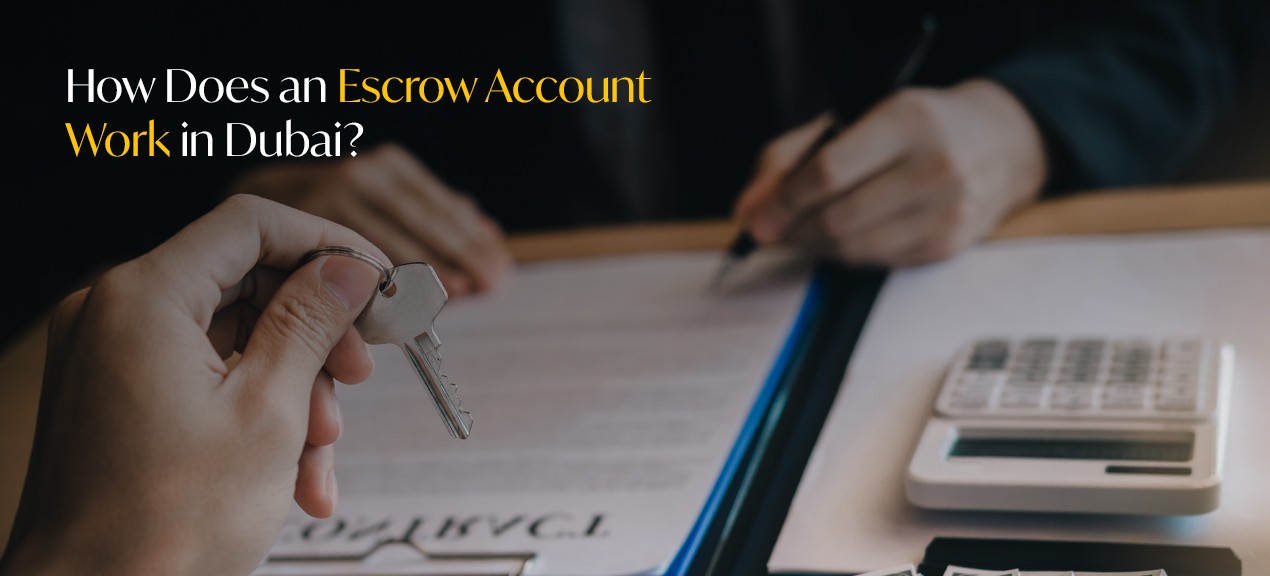
How Does an Escrow Account Work in Dubai?

escrow in dubai real estate

Here’s a step-by-step breakdown of how the escrow account process works in Dubai:

Step 1: A developer launches an off-plan project.

Step 2: For that particular project, the developer needs to set up a special escrow bank account.

Step 3: Buyers make payments according to the payment plan.

Step 4: Only after building progress has been verified are the funds released in phases.

Step 5: The escrow trustee approves milestone-based fund withdrawals.

This system guarantees:

  • The money is only utilized for approved expenses, construction, land payments, and consultancy.
  • Developers are not allowed to misuse buyer payments.
  • Projects proceed in accordance with established timelines.

Developers must adhere to all RERA requirements and Dubai escrow account law if they wish to release further funds.

Dubai Escrow Account Law & Regulations

Strict real estate laws are in place in Dubai to safeguard investors. Among the important laws are:

1. The Land Registration Law, Law No. 7 of 2007

This law establishes the legal foundation for escrow compliance and property registration.

2. The Real Estate Sector Regulation Law No. 13 of 2017

This law makes escrow accounts a need for off-plan properties in Dubai. In accordance with these rules:

  • There must be an escrow account for each off-plan project.
  • The specified escrow account must receive all buyer payments.
  • Only after confirmed construction progress can funds be provided.

These RERA rules for Dubai real estate are designed to boost investor confidence and transparency.

Why Are Escrow Accounts Mandatory in Dubai?

escrow accounts in dubai

When it comes to escrow accounts, Dubai is very strict. because they protect buyers from:

  • Fraud by developers
  • Financial mismanagement
  • Project termination
  • Misuse of finances

Your money is directly linked to the status of construction when you invest in an escrow-protected investment in Dubai.

Buyer protection under Dubai property law guarantees that your money can be retrieved in accordance with RERA regulations in the event that a project is significantly postponed or canceled, or if the developer files for bankruptcy. This is one of the main reasons why international investors trust in Dubai’s off-plan real estate sector.

How to Verify an Escrow Account in Dubai?

Always conduct due diligence before making an investment. Here’s how to verify an escrow account in Dubai:

  • Check the project’s escrow details via DLD platforms
  • Verify the project’s RERA registration.
  • Examine the escrow trustee information for the developer.
  • Make sure the selected escrow account is mentioned in your SPA (Sale & Purchase Agreement).

How Are Escrow Accounts Set Up by Developers?

Only licensed developers can set up an escrow account. Here’s a step-by-step process:

Only developers with a license can create an escrow account. The whole procedure consists of

  • Using the Oqood system to register the project
  • Submitting the required documentation
  • Escrow trustee examining adherence
  • DLD’s regulatory approval
  • Connecting the escrow structure to the project payment plan

In Dubai, every project needs its own escrow bank account. Funds from one project cannot be used for another, which adds another layer of security.

Benefits of Escrow Accounts in Dubai Real Estate

escrow accounts in dubai real estate

Escrow accounts have several benefits such as 

  1. Increased Security: Funds are legally protected by Dubai property legislation.
  2. Enhanced Transparency: Accountability is established through milestone-based releases.
  3. Complete Transaction Records: Every payment is monitored by escrow trustees.
  4. Decreased Risk: Prevents financial mismanagement, fraud, and misuse.
  5. Increased Investor Confidence: Foreign investors are more comfortable investing in Dubai.

For this reason, escrow protection is often linked to safe real estate transactions in the United Arab Emirates.

Conclusion: Why Is Dubai Among the Safest Markets Due to Escrow Accounts?

Escrow accounts are the backbone of buyer protection in Dubai real estate. They ensure:

  • Your money is safe.
  • Funds are dependent on the actual status of work.
  • Developers adhere to strict compliance guidelines.
  • Transparency is upheld throughout.

When investing in off-plan property in Dubai, make sure to select projects with reliable developers and strict escrow compliance. By establishing structure, responsibility, and regulation, Dubai developed trust and became a global investment destination.

And escrow accounts in Dubai real estate are a big part of that trust. Visit luxliving to check the latest escrow-protected off-plan properties in Dubai and make informed investment decisions.

FAQs

1. How do escrow accounts work in Dubai?

In Dubai, buyers’ money for off-plan properties is safely held in an escrow account. To protect buyers from fraud or project delays, funds are only disbursed to the developer following RERA-verified construction milestones.

2. What happens in Dubai after 99 years of leasehold?

You have the right to use and occupy the property for the duration of a 99-year lease. Unless a new lease is signed, rights return to the freeholder after expiration.

3. What is Dubai’s escrow account law?

According to Law No. 8 of 2007, all payments for off-plan real estate must be deposited into an escrow account designated for the developer. Only after confirmed milestones are funds disbursed, guaranteeing buyer protection and transparency.

4. How to check an escrow account in Dubai?

You can verify details with the developer or use the Dubai REST app or DLD portal to validate an escrow account. Prior to making any payments, confirm that the account has been approved by RERA.

Dubai Real Estate Market Soars to $19.7 Billion in Record Start to 2026

Dubai Real Estate Market Soars to $19.7 Billion in Record Start to 2026
dubai real estate 2026

Dubai’s real estate market has started with a spectacular transaction value of a record AED 72.4 billion ($19.7 billion) for January 2026. This is a 63% gain over the previous year, highlighting that both investors and purchasers are very confident for both off-plan and ready properties.

Off-Plan Properties Leading the Way

This growth is being driven by the primary market, particularly off-plan properties in Dubai. While ready properties in the primary market increased 49% in January, off-plan property values in new developments increased 128% year over year. Buyers are attracted to new buildings that provide contemporary architecture and flexible payment plans because they trust developers.

Off-plan properties in the secondary market, on the other hand, saw a slight decline, with volumes dropping 27% and prices down 9%, indicating that buyers prefer to buy directly from developers for new projects.

Secondary Market Remains Strong

Dubai’s secondary market, which includes ready-to-move-in properties, is still a big component of the market. The whole value of the secondary market grew by 38% over the previous year. Nearly 89% of the market is made up of ready-to-move-in properties, whose values have increased by 48% and transaction volumes by 8%. Individuals are seeking residences that provide a high rental income or that they can move into right away.

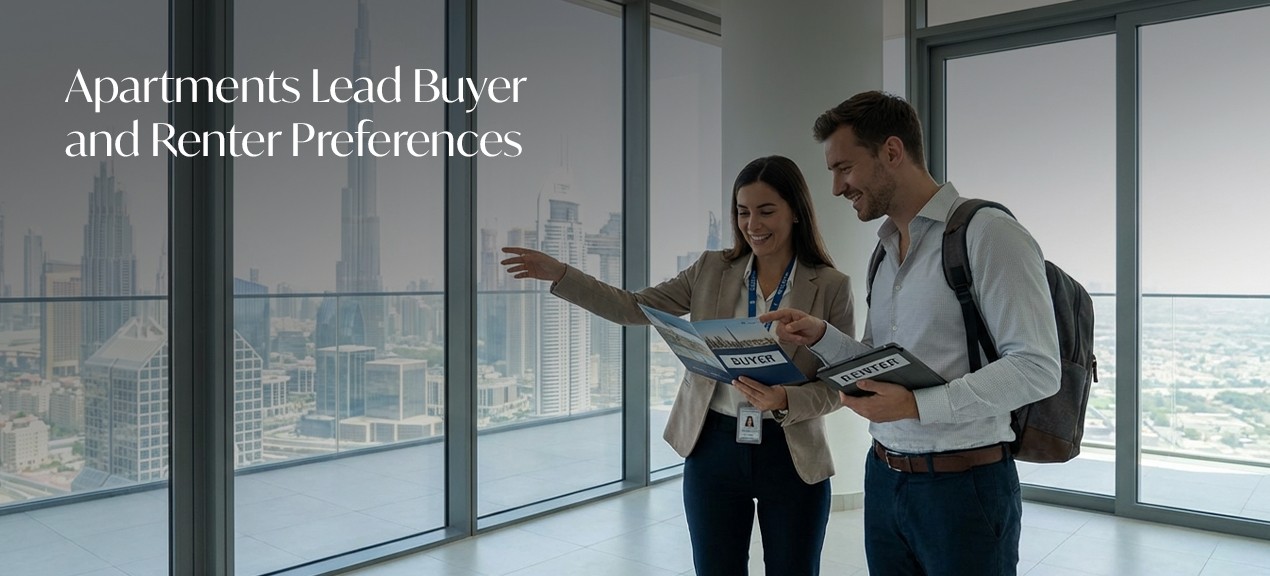
Apartments Lead Buyer and Renter Preferences

apartments in Dubai

Renters’ and buyers’ decisions are still influenced by affordability and convenience. Renters’ (78%) and buyers’ (59%) searches are dominated by apartments, with townhouses and villas making up the remaining demand. One- or two-bedroom apartments are particularly popular, and this reflects Dubai’s growing rental costs and the need for small, reasonably priced houses in well-connected neighborhoods.
Premium Buyers Boost Villas and Townhouses

The demand for luxury villas and townhouses is being driven by high-income buyers who make over AED 40,000 a month. In the meantime, the primary entry point for people making less than AED 40,000 is still apartments. The majority of mortgage-backed transactions (more than 80%) are associated with apartments. Over 85% of all market transactions are made by owner-occupiers, showing that the market is still driven by end users.

Mortgage Market Boosts Buying Power

dubai real estate mortgage market

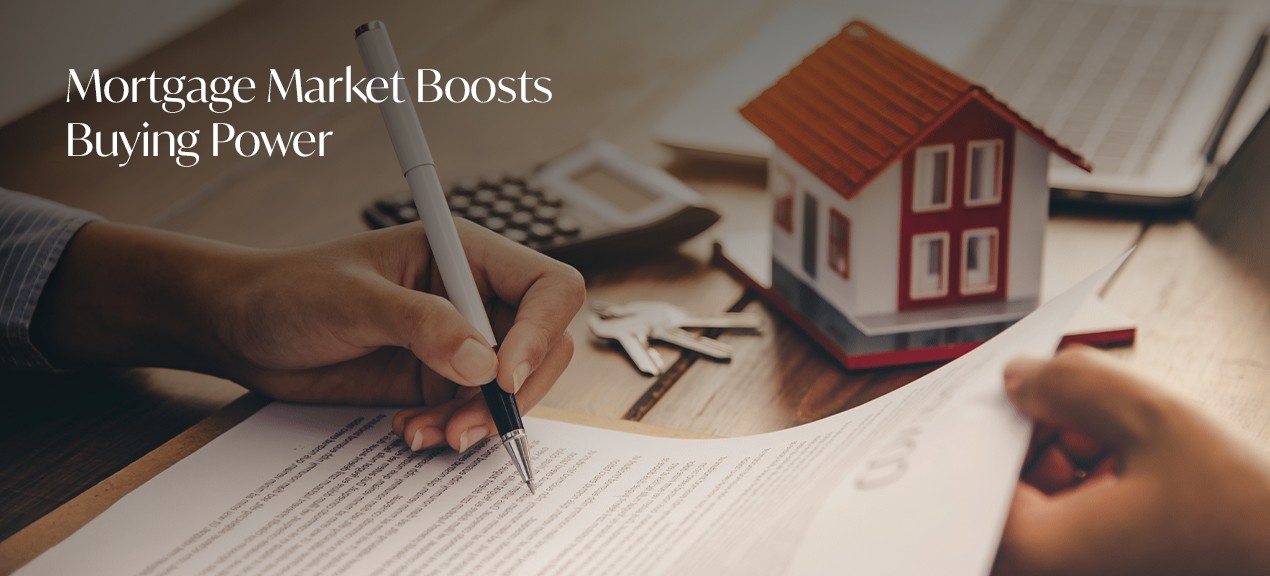
With volumes and prices up 30% annually, Dubai’s mortgage sector is still growing. Buyer affordability has increased as a result of declining interest rates, with the average three-month EIBOR falling from 4.0% to 3.5%. Mortgage financing is still a major factor in gaining access to higher-value properties in Dubai, especially with several handovers expected in 2026.

Market Outlook  

Meanwhile, the Dubai Land Department (DLD) and the Virtual Assets Regulatory Authority (VARA) are set to launch a pilot program to tokenize 7.8 million assets, enabling fractional ownership and a digital secondary market. This innovation improves transparency, accessibility, and investment opportunities.

Takeaway for Investors and Purchasers

Dubai real estate 2026

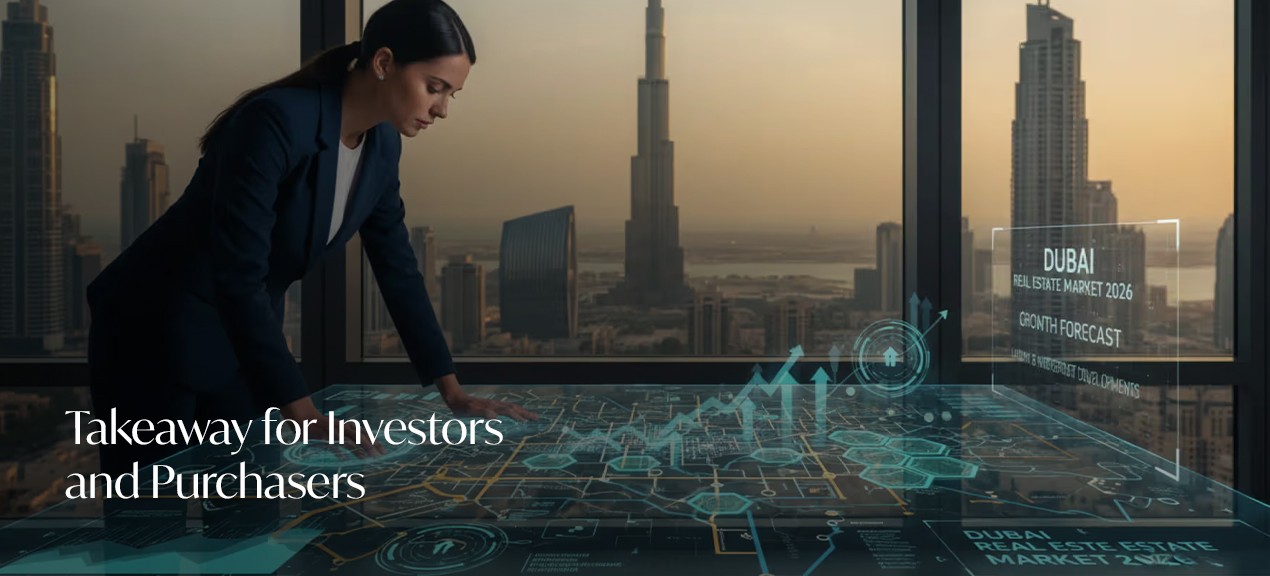
The Dubai real estate market is strong and well-balanced in early 2026. Off-plan demand is increasing, ready-to-move-in properties are still worth their price, and mortgage support is assisting purchasers. Dubai continues to offer opportunities for investors and end users in a transparent, controlled, and continually expanding industry.

For more information and to explore the best properties in Dubai, visit our website at Luxliving.ae.

Also Read:

Dubai Real Estate Records AED 111 Billion in Transactions at the Start of 2026

Dubai Real Estate Records AED 111 Billion in Transactions at the Start of 2026

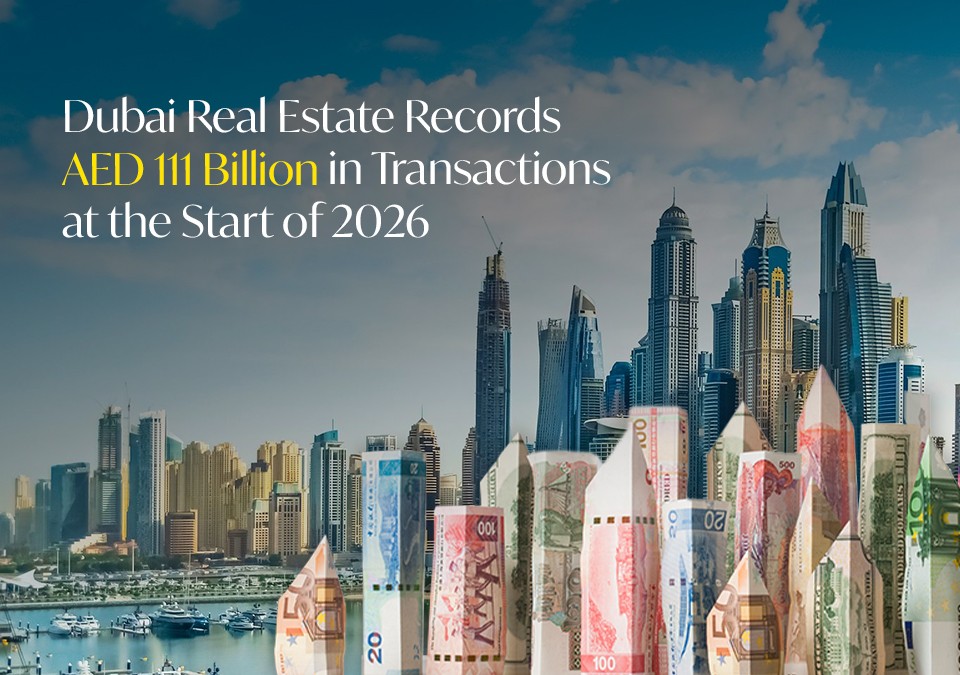
The Dubai real estate market had a strong start to 2026. The Dubai Land Department reports that real estate transactions totaled AED 111 billion ($30.22 billion) in January 2026, an 88 percent increase over January 2025.

Strong demand throughout the market was confirmed by the 22,108 total real estate transactions, which represented a 24 percent year-over-year increase. This impressive start highlights the increasing trust of investors and solidifies Dubai’s standing as one of the top real estate investment locations globally. 

Increasing Market Participation and Investor Activity

dubai real estate tranaction

By early 2026, investor participation continued to rise. In January alone, 10,427 new investors entered Dubai’s real estate market, which is a 35% increase compared to the same period last year.

This expansion highlights the growing number of investors and growing confidence in Dubai’s real estate market, which is driven by well-defined rules and disciplined market practices.

Strong Momentum Built on a Record-Breaking 2025

dubai real estate transaction

The performance in January 2026 builds on an exceptional year for Dubai real estate in 2025.  Over 270,000 real estate transactions of AED 917 billion ($249.69 billion) were registered during the year, indicating a 20% increase from the previous year.

In 2025, sales, leases, and real estate services were recorded for 3.11 million of all real estate transactions. This was a 7% rise over 2024, indicating growing demand and the sector’s expanding contribution to Dubai’s economy.

Performance of Luxury Properties and Important Transaction Areas

dubai real estate transactions

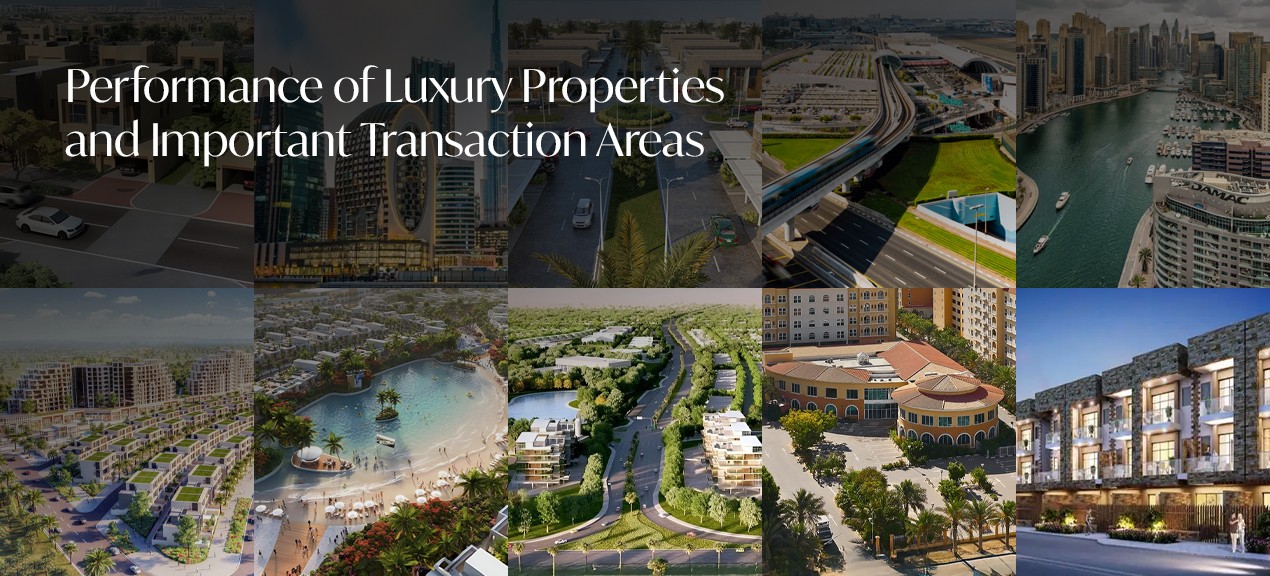
Investments in luxury Dubai real estate reached AED 3.98 billion, representing a 5% increase. The statistics also revealed that it took an average of 4.8 years for a renter to become an investor in real estate, highlighting the growing appeal of property ownership in Dubai.

Al Barsha South Fourth, Business Bay, Wadi Al Safa 5, Dubai Airport City, Dubai Marina, Jebel Ali First, Al Yelayiss 1, Wadi Al Safa 3, Dubai Investment Park Second, and Al Thanyah Fifth were the areas with the highest transaction volume.

Business Bay, Dubai Marina, Palm Jumeirah, Burj Khalifa, Al Barsha South Fourth, Mohammed Bin Rashid Gardens, Dubai Airport City, Wadi Al Safa 5, Wadi Al Safa 3, and Al Yelayiss 1 were the best-performing areas by transaction value.

Dubai Real Estate Outlook for 2026

The Dubai real estate market is making steady progress toward the objectives of the Dubai Real Estate Sector Strategy 2033, which seeks to increase transaction volumes to AED 1 trillion, as seen by the strong start to 2026. The Dubai Economic Agenda D33, which aims to improve Dubai’s standing in the world economy, is also supported by this expansion.

As 2026 progresses, Dubai’s real estate market continues to show stability, scalability, and long-term potential with expanding transaction values, increasing investor engagement, and steady performance across key areas.

Dubai Expands Its Role as the Global Center for Branded Residences

Dubai Expands Its Role as the Global Center for Branded Residences

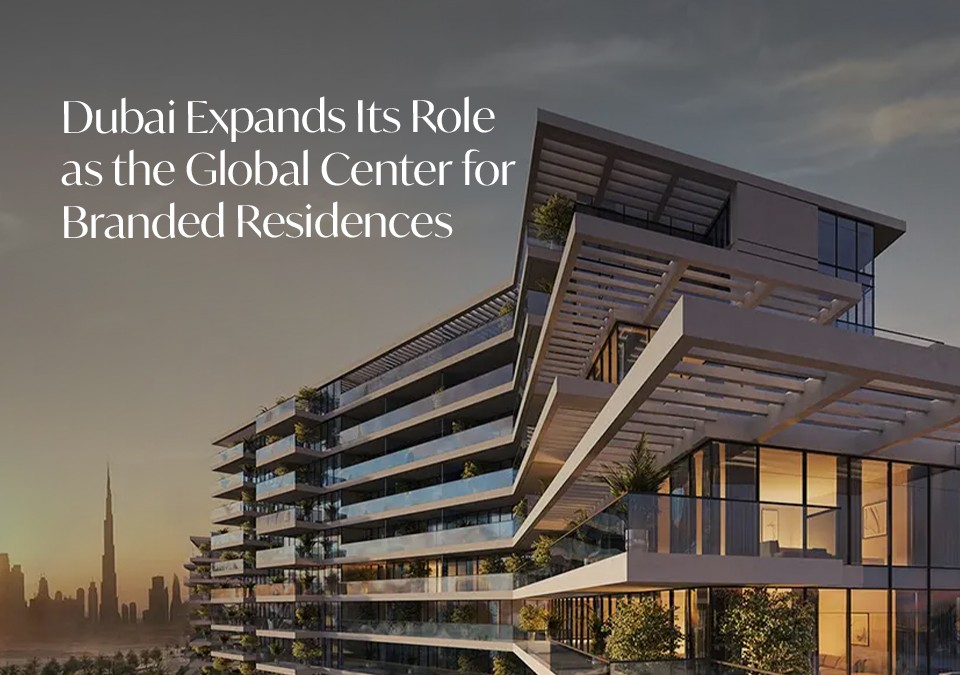
Dubai has once again strengthened its place as the global capital of branded residences, backed by strong demand from high-net-worth individuals, record-breaking project launches, and a fast-expanding development pipeline.

According to the latest 2025/2026 reports on Branded Residences, Dubai outperforms major international cities like Miami, New York, and London in both finished and upcoming branded residential developments. 

A Statistics on Dubai Branded Residences 

The following impressive numbers support Dubai’s supremacy in the market for branded homes:

  • 64 branded home projects have been finished.
  • As of the end of 2025, there were 87 projects currently in the pipeline.
  • There are now about 150 branded housing projects in the emirate.
  • 250 projects are expected by 2030, a nearly 80% increase.

Within the Middle East and North Africa (MENA) area, Dubai is the clear leader, accounting for the majority of finished and future developments.

Growth of the Global Branded Residences Market

Dubai Branded residences

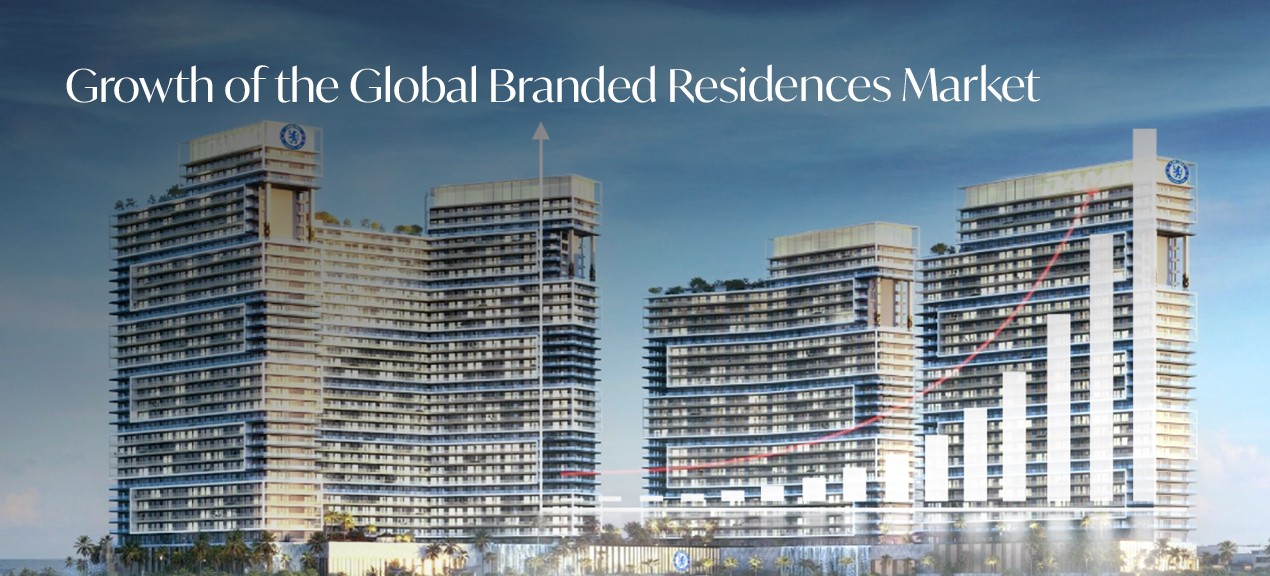
The branded residences sector is experiencing rapid global expansion:

  • 19% growth year over year
  • In 2025 alone, more than 220 new projects were added to the global pipeline.
  • Over the last five years, the MENA region has grown at one of the quickest rates in the world, at 187%.

This growth reflects increasing buyer preference for lifestyle-led properties backed by globally recognized brands.

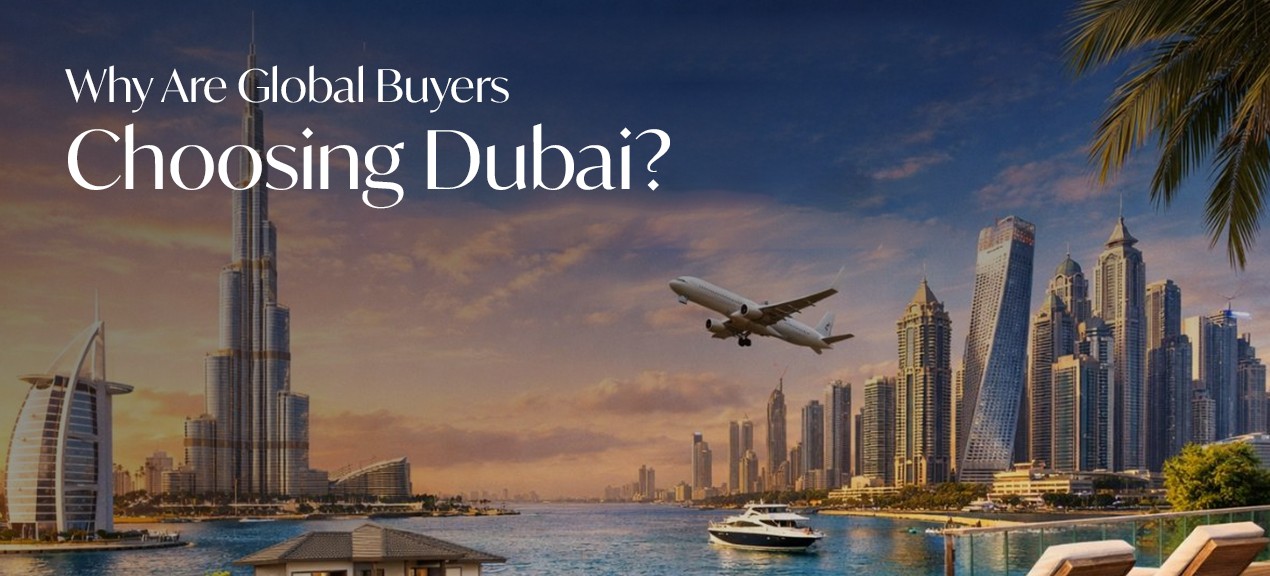
Why Are Global Buyers Choosing Dubai?

Dubai Branded residences

Several factors continue to drive international demand for branded properties in Dubai:

1. Tax-friendly Environment

Dubai is a popular location because of its attractive tax structure, which includes neither an income tax nor a capital gains tax.

2. Capital Security 

For international investors looking for long-term stability, Dubai is one of the most secure and reliable investment markets.

3. Connectivity & Lifestyle

Dubai is positioned as a truly global gateway because of its top-notch infrastructure, international connectivity, and luxurious lifestyle options.

Major Branded Residence Launches Fueling Growth

Dubai Branded residences

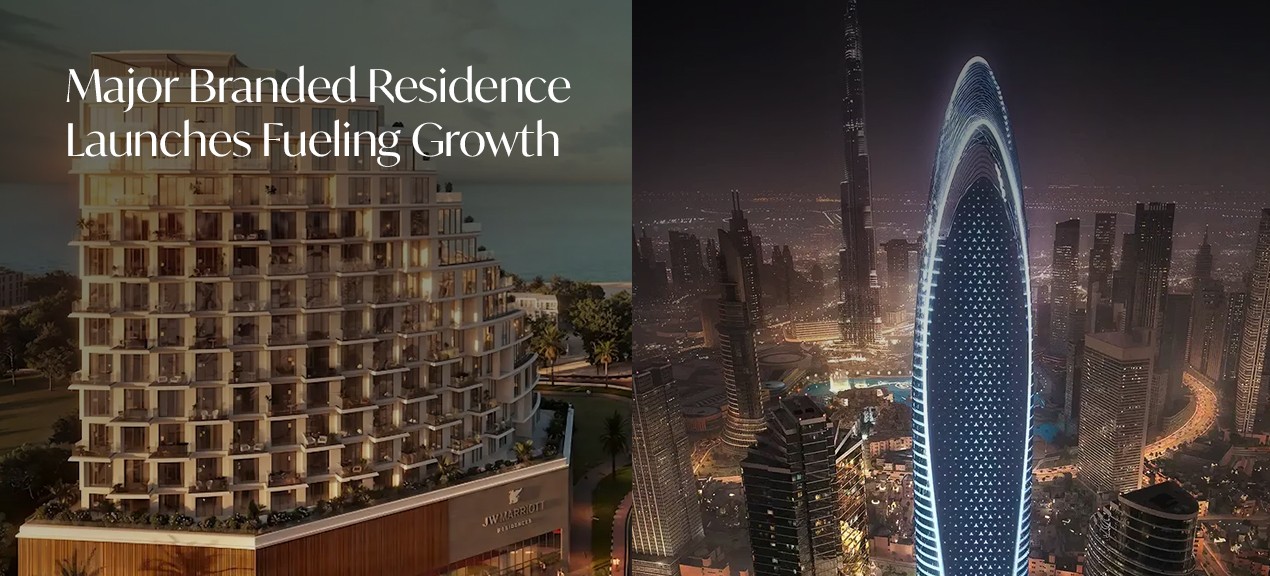
Dubai’s market growth has been accelerated by a number of high-profile launches:

1. Binghatti’s Mercedes-Benz Locations

  • A multi-tower project worth Dh30 billion
  • adds thousands of branded units to the skyline of Dubai.

2. JW Marriott Homes

  • Announced plans to launch branded residences in Dubai, further strengthening hospitality-led developments
  • These launches demonstrate the increasing self-assurance of developers and luxury brands in Dubai’s real estate sector.

Emerging Hotspots in the UAE

While Dubai remains the main hub, other UAE locations are gaining attention for branded residences such as

Ras Al Khaimah

  • 24 branded residential projects are in the pipeline for Ras Al Khaimah.
  • Growing interest from investors as a result of lifestyle-focused developments

Abu Dhabi

  • Emerging as a strong contender as developers diversify beyond core urban markets

These locations are a reflection of the growing demand in the UAE for branded homes with a resort-style and lifestyle focus.

Conclusion: the Future of Branded Residences in Dubai

The market for branded residences in Dubai is expected to continue growing due to the demand from millionaires, growing interest from around the world, and high developer confidence.
Dubai is predicted to have about 250 branded residential complexes by 2030, solidifying its status as the top location for branded luxury living worldwide. If you’re considering investing in branded residences in Dubai, explore available properties on luxliving.ae and be part of this growing market.
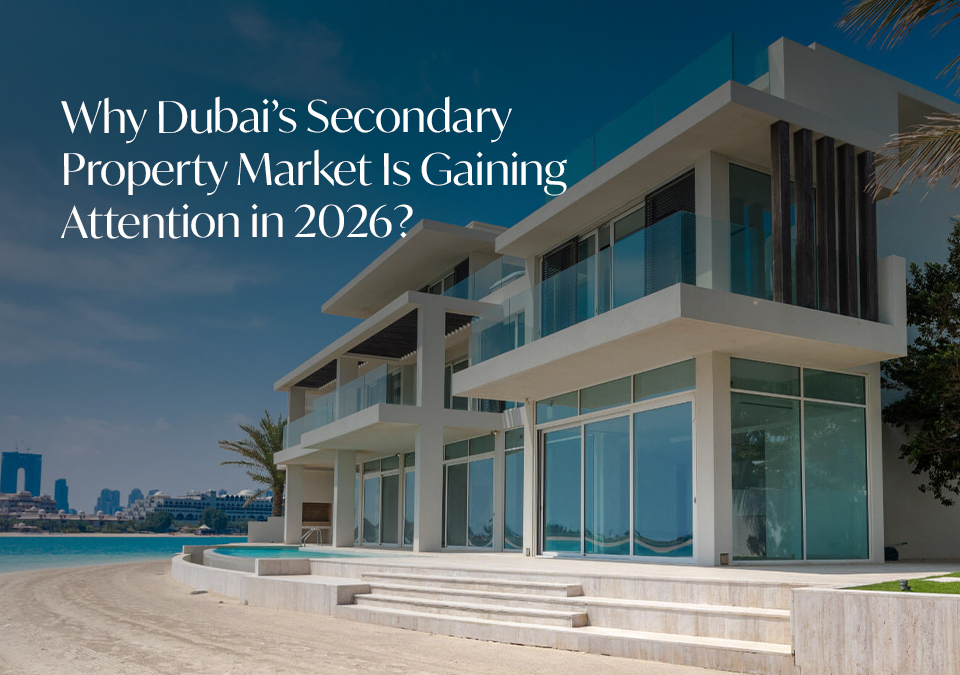
Why Dubai’s Secondary Property Market Is Gaining Attention in 2026?

Why Dubai's Secondary Property Market is gaining attention in 2026

Over the past few years, Dubai’s real estate market has seen significant changes. However, one thing is certain in 2026: the secondary real estate market is receiving increasing attention from investors and buyers.

Instead of focusing only on off-plan property launches, many people are now choosing ready properties. These are homes that already exist, are completed, and can be used or rented immediately.

This change is occurring for simple reasons: certainty, stability, and real value.

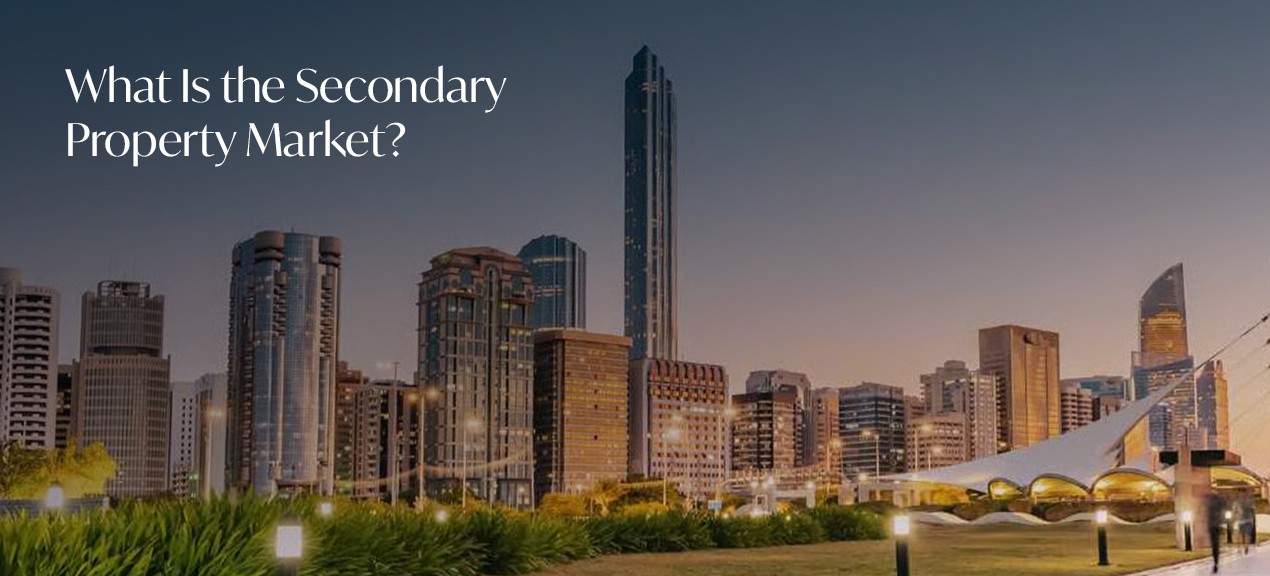
What Is the Secondary Property Market?

Dubai's secondary market

The secondary market means resale properties, which include apartments in Dubai, villas, and townhouses that have already been built and owned before. Unlike off-plan properties, buyers can:

  • See the actual unit
  • Check the building quality
  • Understand the community
  • Move in or rent it out right away

Why Buyers Prefer Ready Properties in 2026?

Dubai's Secondary Market

Here are some reasons as to why the buyers prefer ready properties: 

1. No Uncertainty, No Waiting

Immediate ownership is a major factor in the selection of secondary assets. There are no surprises, no handover dates, and no construction delays. Customers are well aware of what they are purchasing.

This is especially important for families and professionals who are looking to move in quickly or start earning rental income.

2. High Demand from Dubai Residents

Many buyers nowadays are not investors seeking quick flips. They are end consumers, or those who reside and work in Dubai.

They favor:

  • Well-established communities
  • Completed facilities
  • Schools, workplaces, and stores nearby

As a result, there is still a high demand for resale apartments in places like Dubai Marina, Business Bay, and JVC.

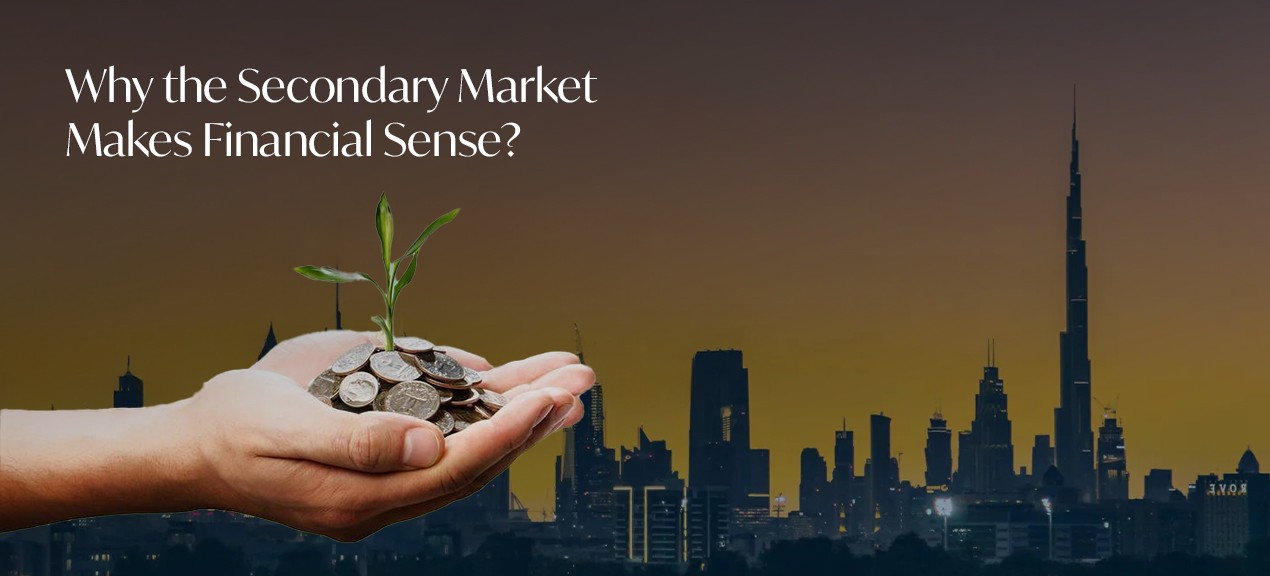
Why the Secondary Market Makes Financial Sense?

Dubai Secondary Market

1. Better Rental Stability

Ready properties come with proven rental demand. Owners can check:

  • Current rents
  • Occupancy levels
  • Tenant demand

As a result, rental income becomes more consistent. Instead of waiting years for price growth, many investors in 2026 would rather have consistent rental returns.

2. Easier to Sell When Needed

Liquidity is another benefit of the secondary property market. It’s simpler to price and sell resale properties because

  • Prices on the market are transparent.
  • Comparable units are currently being traded.
  • Completed properties are trusted by buyers

Investors now have more options if they wish to sell or upgrade later.

3. Limited Supply Is Supporting Prices

 There aren’t many ready homes in established areas, despite the fact that numerous new developments are being built. There isn’t an infinite supply of land in prime locations. New supply slows down after a community is fully developed. This naturally supports long-term property values.

One of the main factors keeping resale properties attractive in 2026 is their restricted supply.

4. An Improved Real Estate Market

In 2026, Dubai’s real estate industry has reached a more advanced stage. Customers are more knowledgeable, prudent, and realistic.

Many people are opting for properties that already offer rather than chasing the next big launch:

  • Space that can be used
  • Income from rentals
  • Daily demand

This is a positive sign for the Dubai real estate market.

Conclusion 

In conclusion, the secondary real estate market in Dubai is no longer a backup option. In 2026, it has evolved into a smart and practical option for end users and investors. Due to the ready properties, consistent rental income, and reduced risk, secondary homes offer genuine value in today’s competitive real estate market.

Therefore, understanding the secondary market is essential for anyone looking to buy real estate in Dubai. To make a smart investment in Dubai’s thriving property market, explore the latest secondary properties on Luxliving Real Estate and start building steady rental income today.

Emirates to Construct a Multi‑Billion‑Dirham Cabin Crew Village in DIP

Emirates to Construct a Multi‑Billion‑Dirham Cabin Crew Village in DIP

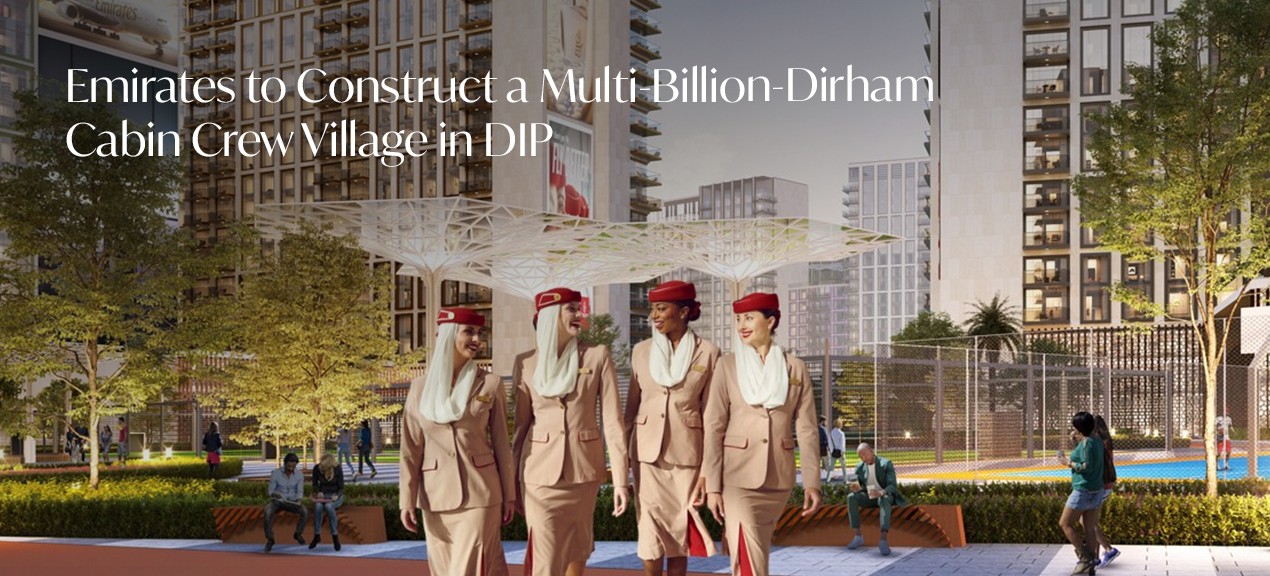
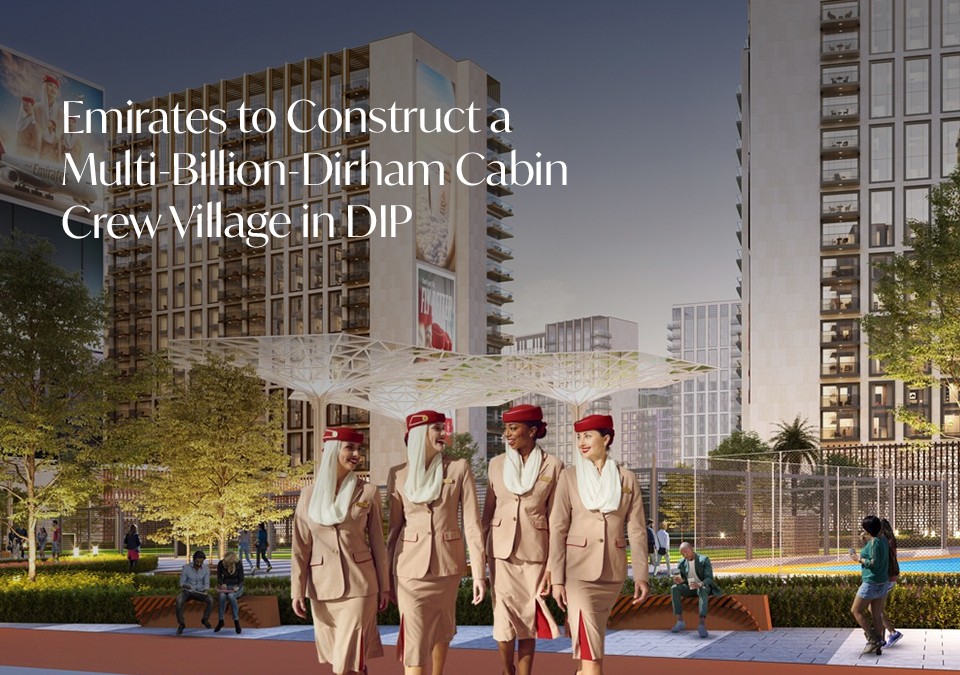
The Emirates Airline has announced plans to construct a multi-billion dirham Cabin Crew Village, a first-of-its-kind residential and mixed-use community intended to promote the lifestyle and well-being of its cabin crew employees in Dubai Investments Park (DIP). This multi-billion dirham development will accommodate up to 12,000 Emirates cabin crew members, which represents the airline’s long‑term growth strategy and investment in people.

The first phase is expected to be finished by 2029, with groundbreaking planned for mid-2026. The project will be delivered under a long-term lease arrangement between Emirates and Dubai Investments Park, enhancing DIP’s role as a key hub for Dubai’s residential and commercial development.

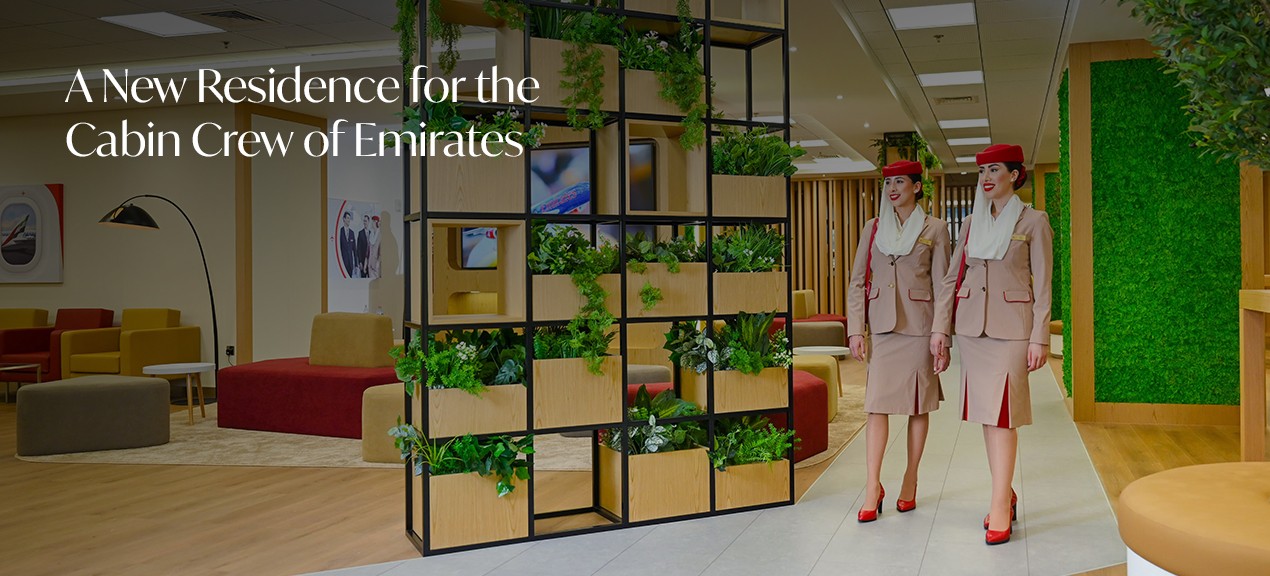
A New Residence for the Cabin Crew of Emirates

Emirates Cabin Crew Village in DIP

Emirates‘ reputation for providing exceptional customer service is largely attributed to its cabin staff. The airline is investing in a living environment that goes beyond standard staff accommodation because thousands of crew members travel across continents every day.

The Cabin Crew Village will be built on a large plot of land in Dubai Investments Park, a neighborhood renowned for its access to important airports and major highways. The location supports current airline operations and aligns with Emirates’ long-term focus on Al Maktoum International Airport. It is situated approximately halfway between Dubai International Airport (DXB) and Dubai World Central (DWC).

Designed with Community, Comfort, and Convenience in Mind

The Cabin Crew Village is being designed as a self-contained, fully integrated lifestyle destination, rather than traditional crew housing. The master plan consists of:

  • 20 modern residential buildings with one-, two-, and three-bedroom apartments in Dubai to accommodate a range of lifestyles, each with up to 19 floors.
  • A central hub for the community that offers daily services, eateries, retail stores, and cafes.
  • Fitness facilities and wellness spaces are designed to support busy, irregular work schedules.
  • Healthcare clinics and public spaces to promote mental and physical well-being.
  • Wellness areas and fitness centers to accommodate hectic, irregular work schedules.
  • Public areas and medical facilities to support mental and physical health.
  • Resort-style swimming pools, beautifully designed gardens, and outdoor walking and jogging routes all promote leisure and social contact.

Furthermore, each residential structure will have specific amenities to enhance accessibility and convenience, making it easier for cabin crew to carry out their daily tasks regardless of shift patterns.

A Focus on Health and Lifestyle

Emirates Cabin Crew Village in DIP

The project’s emphasis on quality of life is one of its most notable aspects. According to Emirates, the village is meant to provide more than just a place to sleep; it’s a place where crew members can unwind, socialize, and take advantage of a friendly living atmosphere.

The development’s architecture promotes physical exercise and meaningful downtime by incorporating outdoor areas and planted green spaces. These areas will support balance and well-being by mitigating the difficulties of long-distance travel and frequent time zone shifts.

Operational Efficiency through Strategic Location

When planning the Cabin Crew Village, location was a major factor. It provides quick access to Emirates’ activities across the city, as it is located between Dubai’s two primary aviation hubs, DXB and DWC. The airline’s overall operating plan, which includes its future focus on Al Maktoum International Airport as passenger and cargo services continue to grow, is supported by this strategic location.

Major road networks are easily accessible, improving connectivity and facilitating everyday travel and commuting.

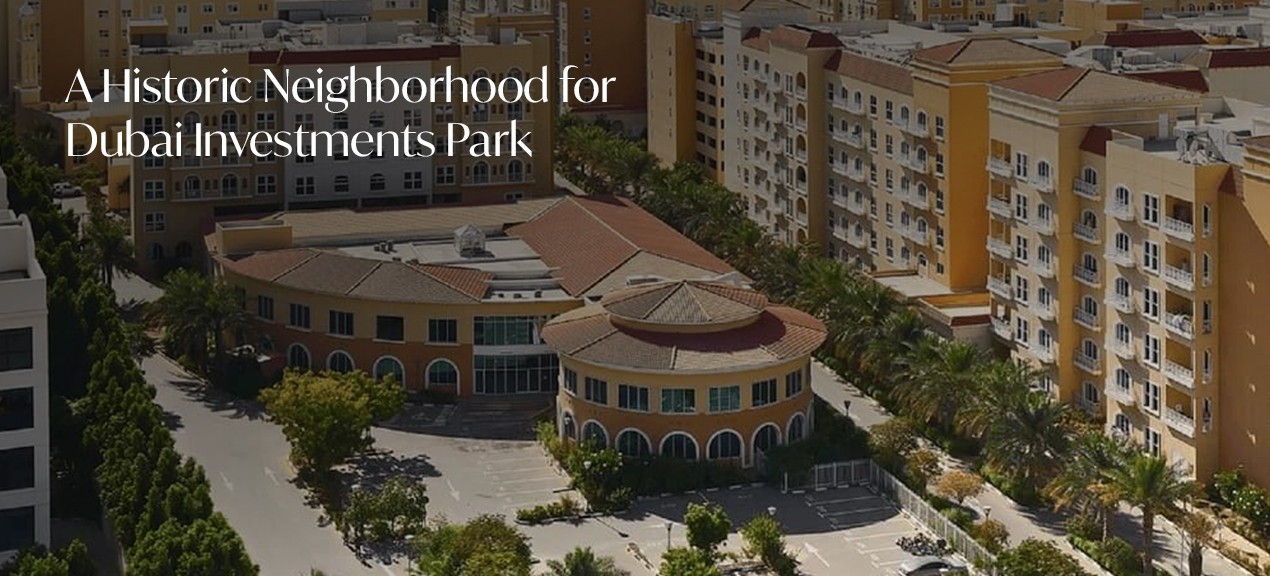
A Historic Neighborhood for Dubai Investments Park

Dubai Investments Park will become an even more vibrant, mixed-use center with the addition of the Emirates Cabin Crew Village. The project will strengthen the local economy, improve social infrastructure, and improve lifestyle options throughout the region by housing thousands of people in a well-planned community.

The Cabin Crew Village supports Dubai’s standing as a major aviation and business hub by being one of the biggest purpose-built airline personnel villages in the Middle East. By combining residential comfort, community amenities, and necessary lifestyle facilities in a single integrated environment, Emirates is establishing a new standard for employee-centric buildings. By redefining contemporary staff housing, this project demonstrates how human-centered, strategic design can benefit people and the larger community.